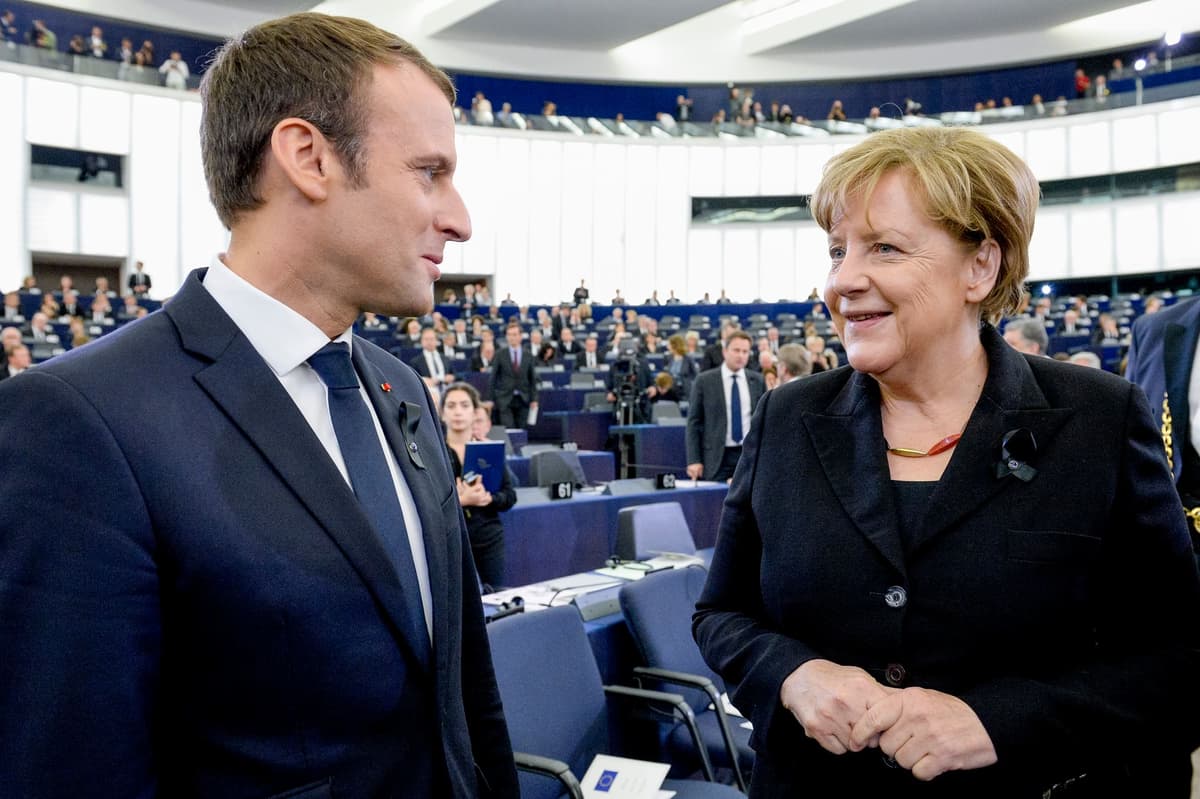
The ‘French-German Axis’ within the European Union has reached a guiding compromise on the funding of the new corona mega-fund. This also clears an important obstacle for the new EU multiannual budget 2021-2027.
French President Emmanuel Macron and German Chancellor Angela Merkel agreed on a European support fund of 500 billion euros, which is to become part of a revised workload for the European Union. The most notable aspect is that virtually no EU country gets exactly what it wants, and most countries will have to accept something they have previously opposed.
Moreover, Macron and Merkel avoid the controversial dividing line of whether payments from this new corona fund are unconditional grants or donations, or subsidies and loans under conditions. They also do not specify which country can receive how much, nor which country will have to contribute how much.
The governments of the southern European countries Spain, France, Italy, Greece, Portugal, and Cyprus were clear last week: the EU must come forward as soon as possible with the recovery fund worth 1.5 trillion euros, three times as much as currently on the negotiation table. So they do not get what they asked for, and must wait and see how much they will or will not have to repay.
The southern European request was not warmly received by the (‘strong economies’) northern European member states such as the Netherlands, Germany, Austria, Denmark, and Finland. They consider 1.5 trillion euros too much, oppose a grant, favor a loan, and think September is still too early. Chancellor Merkel already acknowledged last week that Germany will have to contribute more to the EU budget from now on.
“The goal is to emerge from this crisis stronger and more united as Europe,” Merkel said. “This money is for that purpose. This extraordinary one-off effort is intended to support the hardest-hit countries.”
The now calculated 500 billion will have to be borrowed by the European Union on the capital markets (with interest rates currently very low), with the 27 EU countries each guaranteeing a (yet unspecified) portion. The allowed debt burden in Europe must be increased, say Macron and Merkel.
With this, they seem to be taking a step toward issuing ‘eurobonds’ (debt securities), which so far have met with a German ‘no’. In addition, Macron and Merkel pave the way to tapping ‘new sources of revenue’ within the EU budget, jargon for new taxes at the European level.
EU taxes could include an internet profit tax, or a CO2 climate tax on imported products, an environmental tax on disposable plastic bottles, or a European road user charge based on kilometers driven. According to the two leaders, the financing plan was developed after consultations with, among others, the Netherlands and Italy.
Chancellor Merkel called the now reached French-German compromise the “plan for the short term.” Plans for the medium and long term still have to be developed. There is still uncertainty about who (which countries) will ultimately have to pay/repay the mega debt, and whether it follows the current EU distribution keys or whether the strongest shoulders will bear the heaviest burdens.
Furthermore, no timeframes are given, which could also mean that the mega debt will be declared ‘repayment-free,’ as ‘perpetual loans.’ According to Macron, European solidarity is important in fighting the crisis.
The currently presented financial compromise broadly corresponds to the earlier French-German strategy note (‘non-paper’) on the future of the European Union and the reforms and modernizations desired by Paris and Berlin. The Brexit departure of the British would be used to thoroughly review the EU organization and tasks once again. This initiative would be launched under the French EU presidency at the end of 2020 and would be completed under the German presidency at the start of 2020 (‘Merkel’s farewell party’).
European Commission President Ursula von der Leyen is pleased with the proposal, which “rightly emphasizes the need to work toward a solution centered on the European budget.” According to her, it “moves in the direction” of the plan the Commission itself is working on. That proposal, consisting of the adjusted EU multiannual financial framework (MFF) and a corona recovery fund, will be presented next Wednesday.
The linkage between these two extensive financial dossiers does not seem like good news for the eastern EU member states, which rely heavily on financial support from current EU structural funds, rural investments, agricultural subsidies, and other specific payouts.
Because the new EU Climate Policy (‘Green Deal’) will be included in this multiannual budget, eastern EU countries such as Poland, Lithuania, Romania, and Bulgaria fear that their cherished subsidies will be ‘converted’ into Green Deal subsidies. Ultimately, all 27 EU countries must approve the plan before it can be implemented.