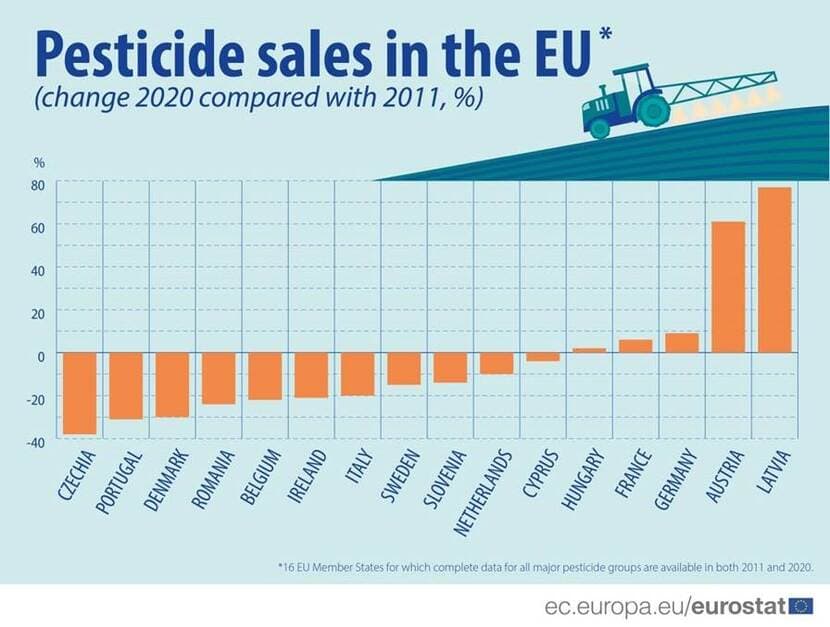
Despite progress in some EU countries, the use poses a significant risk, the agency concludes in a recently published analysis.
According to that research, pesticide use has remained relatively constant in EU countries over recent years. From 2011 to 2020, approximately 350,000 tons were sold annually. The largest quantities of most active substances were sold in Germany, France, Spain, and Italy – the four largest agricultural producers in the EU.
According to the environment agency, EU countries need to do much more to achieve the EU goal of halving the risks of chemical pesticides within a few years. Dependence on such substances can, for example, be reduced by switching to organic farming or using ‘natural’ agents, it is stated. Most EU countries believe that there must first be more alternatives on the market before chemical substances can be banned.
Negotiations over the Commission proposal for ‘less chemistry in agri’ are more or less stalled because the previous presidency (Czech Republic), at the urging of several Agriculture Ministers, asked the European Commission for new data.
EU Commissioner Stella Kyriakides (Food Safety) said this week that in June she will send an updated overview of pesticide use per country to the current (Swedish) presidency of the EU Council of Ministers. Swedish Agriculture Minister Kellgren said he intends to discuss that report directly afterward with the Agriculture Ministers.
Agriculture Commissioner Janusz Wojciechowski made no secret of his agreement on Tuesday at a press conference in Luxembourg with the widely expressed criticism that not all EU countries can be treated the same in new legislation. There are countries where at most one kilogram of this substance is used per hectare, and in other countries ten times that amount.
The successful reduction in recent years in various countries must in some way, according to him, be ‘rewarded’.