EU Health Commissioner Stella Kyriakides has put the Farm to Fork laws back on the agenda for the weekly Commissioners' meeting next Wednesday.
These laws form the European legal framework for reducing chemical pesticides and fertilizers in agriculture and for expanding organic farming.
Earlier this year, these laws — under pressure from the war in Ukraine and lobbying from agricultural circles — were removed from the Commission's agenda. Ten EU countries (Austria, Bulgaria, Estonia, Hungary, Latvia, Lithuania, Poland, Romania, Slovakia, and Slovenia) now want to prevent countries from being punished or fined if they fail to meet their pesticide reduction targets.
With the war in Ukraine still ongoing, concerns over food security have increased, and several parts of the Green Deal climate policy have been temporarily suspended or rolled back. Since March, it has been argued that climate objectives should not lead to a "reduction in agricultural production."
The organic proposal would set an EU-wide legal target of a 50 percent reduction in pesticides over eight years. Kyriakides has argued that data shows it is possible to "reduce pesticide use without jeopardizing food security."
It is unknown whether Kyriakides has made adjustments to her earlier texts or if she will submit the package from last March unchanged for a vote.
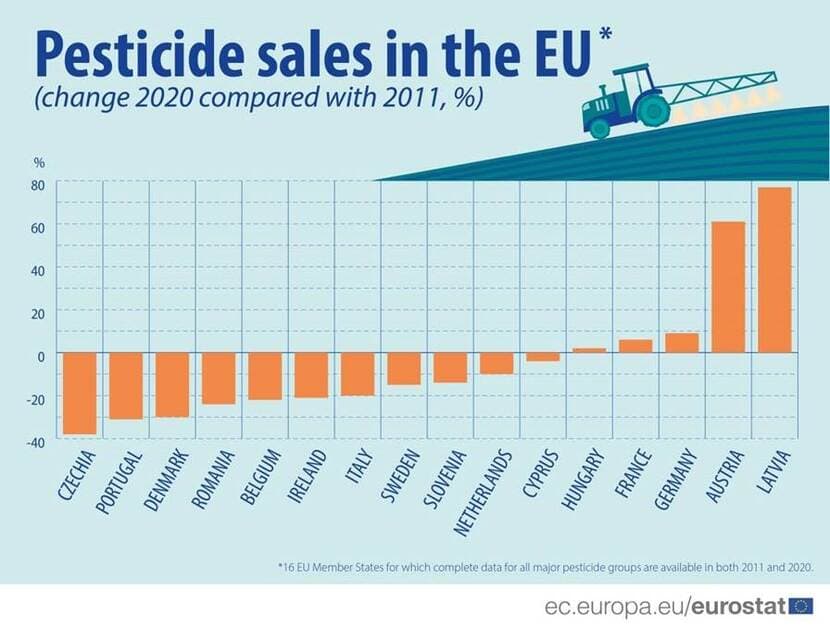
Environmental groups fear new delays or postponements. Meanwhile, a recent report contradicts official claims that the use of toxic pesticides in the EU is declining. This is evident, among other things, from the fact that an increasing number of fruits and vegetables contain pesticide residues. The sale of pesticides in the EU has remained stable since 2011, according to Eurostat data.
The new EU law is also considering a complete ban on pesticides in public spaces such as parks, playgrounds, or nature conservation areas.
Within the European Commission, Climate Commissioner Frans Timmermans is responsible, among other tasks, for combating air pollution; Environment Commissioner Virginijus Sinkevičius handles soil and water pollution; and Kyriakides is responsible for animal welfare, food, and biodiversity. Parts of their regulations and laws also apply to other policy areas, such as the Economy or Agriculture.
It is known that European Agriculture Commissioner Janusz Wojciechowski prefers that the future common agricultural policy (CAP) of the EU countries be elaborated first, including the national strategic plans, to clarify the situation for farmers. Others, however, believe Wojciechowski should also cooperate in implementing laws from the other commissioners.