

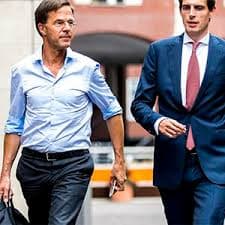
The Dutch coalition government is facing increasing criticism from its own advisors and top figures regarding the Dutch objections to European financing. Even the president of the Dutch Central Bank, a former prime minister, and the influential leader of employer organizations believe that The Hague should not be so stingy but rather generous.
Along with a few other EU countries, the Netherlands is resisting the current proposals from the European Commission, which are to be discussed at a video summit on Friday. In particular, the provision of grants from the corona recovery fund is sensitive. Together with Denmark, Sweden, and Austria, the Netherlands had already put forward its own proposal. These 'frugal four' want, among other things, the recovery fund to provide only loans and no grants.
It is precisely these financial institutions, employers, advisors, parliamentary opposition, and banks who have always advised the cabinet to be cautious and prudent with subsidies and payments to that European behemoth in Brussels, who are now urging Prime Minister Mark Rutte and Minister Wopke Hoekstra to overcome their own reservations. With the current resistance, the Netherlands risks not only squandering its own credibility but also reversing European cooperation and integration instead of advancing it.
Promotion
This was not only the plea of employers’ chairman Hans de Boer and Central Bank president Klaas Knot, but also of former Prime Minister Jan Peter Balkenende. For Dutch standards, it is highly unusual for a former prime minister or minister to express an opinion about the policies of their successors. This increasingly shakes the Dutch criticism of Brussels’ mega-plans.
Moreover, that Dutch ‘no’ seems more and more like reasoning and packaging rather than factual and substantive arguments. Behind the EU scenes, many earlier objections of the 'frugal four' have recently been addressed. In reality, it now mainly concerns the fact that EU countries will have to increase their annual contributions. But this is offset by the fact that they will also receive more EU responsibilities in return.
The European Commission’s proposed plan for the 750 billion euro corona recovery fund will eventually pay for itself, says one of the highest and most influential top officials in Brussels. According to the top budget official, the Dutchman Gert-Jan Koopman, economic growth in the coming years will ultimately cover the costs. Initially, the southern EU countries will primarily benefit, he acknowledged. But the Netherlands would also benefit in the long run if Europe as a whole improves. "Everyone benefits," Koopman said, adding that the plan helps keep the European Union together.
President Klaas Knot of De Nederlandsche Bank (DNB) thinks the Commission’s plan is a good starting point for negotiations. But the exact content is, according to him, a political decision. Former Prime Minister Jan Peter Balkenende would like to see the discussion focus less on divisions between “us” and “them.”
Dutch Members of the European Parliament from various parties generally agree with the new EU budget and show no understanding for the rejection by Rutte and Hoekstra. CDA delegation leader Esther de Lange welcomes the proposals. She believes it has taken too long. However, she warned against jointly incurring debts.
D66 welcomes the “European lifeline” and calls on national governments to decide quickly. MEP Sophie in ’t Veld said: “Prime Minister Rutte and Minister Hoekstra really need to realize now that the European interest is also the Dutch interest. Investing in Europe is investing in ourselves.” According to D66, support should be conditional on respect for democracy and the rule of law.
According to Derk Jan Eppink (Forum for Democracy), the corona aid fund is a “political coup” by the European Commission.
Paul Tang (PvdA) calls the proposals “very reasonable” and criticized the four “frugal countries”—the Netherlands, Austria, Denmark, and Sweden. “Watching from your strengthened fortress at a world in flames is not a solution to a global crisis. Now is the time to act together and fairly share the bill.”