

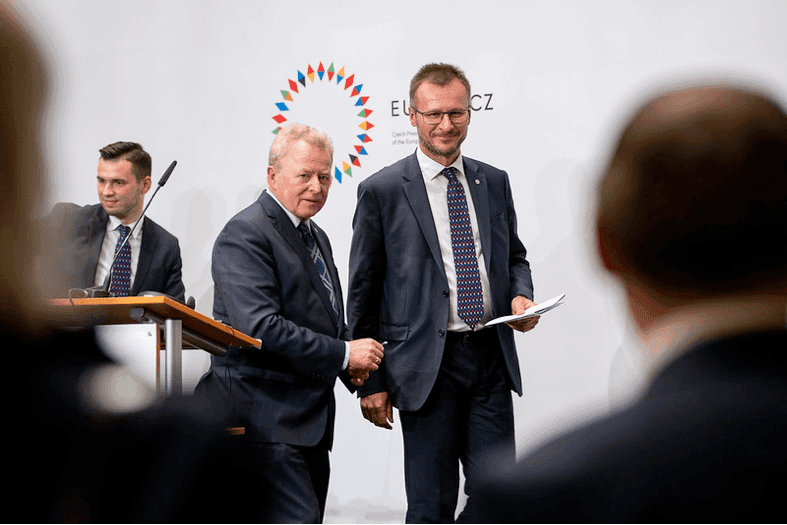
The Czech temporary chair of the European Agricultural Council believes that ‘food security’ should remain an EU priority for the coming six months. However, several Agriculture Ministers pushed at a two-day informal meeting in Prague for an expansion of the EU agricultural plans.
An overview given at the closing press conference revealed that several EU countries are updating their agricultural wish lists. While most ministers still prioritize ‘food security,’ they increasingly also mention ‘energy,’ ‘heating costs,’ ‘fertilizer,’ and ‘farm incomes’ in the same breath.
For example, Spanish and French Agriculture Ministers Luis Planas and Marc Fesneau believe the EU must become ‘autonomous’ in fertilizer production. Czech Minister Zdenek Nekula acknowledged afterwards that the two-day meeting mainly focused on ‘energy and fertilizer.’ He stated that the topic will be on the agenda of the official Agricultural Council, scheduled in Brussels in just over a week.
Promotion
Minister Planas recently said that guaranteed availability of fertilizer for agriculture is an absolute necessity. In doing so, he not only opposes the looming consequences of the Russian gas boycott but also the European Commission’s proposals for ‘less chemicals and more organic.’
Due to the recent sharp rise in gas prices, several chemical companies have virtually shut down production. New Russian threats make normalization of European gas purchases — and consequently the fertilizer market — even more unlikely.
Agriculture Commissioner Janusz Wojciechowski stressed that the EU is currently discussing ‘clawing back’ the windfall profits of energy companies, which would enable EU member states to release funds for state aid for the (collective?) purchase of fertilizer. Earlier this week, Climate Commissioner Frans Timmermans said this could also benefit Dutch greenhouse horticulture.
Spanish Minister Planas reiterated his previous plea that the EU can only reduce the use of chemicals in agriculture if alternatives are available. The earlier proposal introduced by the Netherlands for processing natural manure into dry, spreadable manure powder was not mentioned.
Wojciechowski could not provide clarity about alternatives yet. At a press conference, he repeated his earlier commitment that ‘work is being done on this.’