

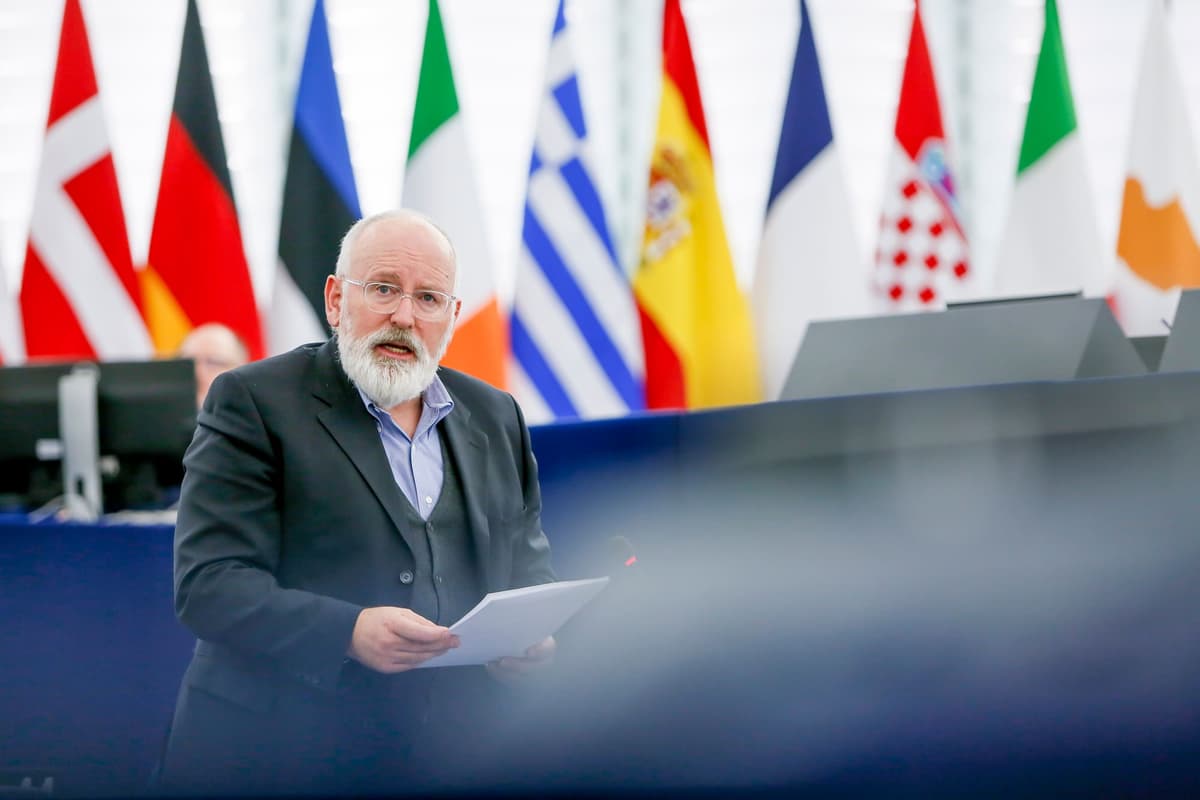
European Commissioner Frans Timmermans will present the first financial frameworks of the EU Green Deal on Tuesday at the European Parliament in Strasbourg. The new European Commission, led by President Von der Leyen and Vice President Timmermans, aims to make the EU sustainable, environmentally friendly, and climate-resilient within thirty years.
For the next ten years, a 'Sustainable Investment Plan' of about 1,000 billion euros is needed. The money must mainly come from reallocating existing posts in the current European budget, supplemented by investments from businesses and co-financing by the EU countries.
The European Green Deal essentially involves a complete shift in the current EU working method, where companies and governments can receive financial support for their own plans, which may differ by country. If in the future the EU only provides support for environmentally friendly projects aimed at reducing CO2 air pollution and non-polluting products, then much will need to be overhauled.
Promotion
The current EU Commission's future plans include large-scale planting of trees and forests, building energy-efficient homes, and installing one million charging stations for electric cars. According to Timmermans, families across Europe could soon lease an electric car for a fixed monthly amount. For this, the European Investment Bank (EIB) must provide cheaper loans to dealers in Eastern Europe, enabling private leasing of electric vehicles.
The European Commission is also working on an import tax on polluting goods that Europe imports from Asian or South American countries. From now on, it will be taken into account whether these goods were produced 'climate-neutrally.' This plan, in which 'CO2 air pollution will be charged at the border,' will be presented next year.
The investment plan is part of the Green Deal agreed upon by EU leaders in December. Only Poland has not yet committed to the agreed target. The country wants first assurance of financial compensation for its efforts. The transition fund may convince Poland to commit.
For this reason, Von der Leyen and Timmermans advocate a separate fund of 100 billion euros for countries where the transition from old, polluting industries to emission-free production will cost disproportionately much effort and money. This primarily concerns phasing out coal mining in Poland and Slovakia.
Funding for that transition fund will consist of a small portion of new EU money. For this, 7.5 billion euros must be allocated in the 2021–2027 multiannual financial framework. EU ministers agree on this 7.5 billion, but not yet on the multiannual budget itself. The Netherlands, Sweden, Denmark, and Austria want to keep that budget at the current 1.00 percent of the total economy; other EU countries are willing to allow a small increase. But the European Parliament and Von der Leyen and colleagues say new money is needed for new tasks.
That 100 billion transition fund will mostly consist of a replacement of existing subsidy pots and the so-called EU structural funds. These currently provide large subsidy flows to EU countries with 'poor regions' or high unemployment, poor infrastructure, or lagging social systems (for many years). EU countries can partly use that 'structural money' for their own projects. Timmermans fears that EU governments may not be eager for such 'reallocation from their own coffers.'
Additionally, Timmermans believes that current EU agricultural subsidies should also be used differently and better: no longer as EU support for large agroconcerns and food producers, but as income support for individual farmers who produce sustainably and environmentally friendly. Resistance is also expected here.