

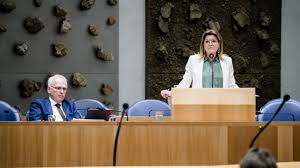
Minister Christianne van der Wal (Nature & Nitrogen) agrees that nature must be better protected and expanded, but fears that in densely populated and built-up Netherlands, this Nature Restoration Law will further block the permitting of large projects.
In an interview with Financieele Dagblad, Van der Wal expresses concern about further 'legalization' of nature policy, including various permits, procedures, objections, and lawsuits. She sees the support for nature conservation steadily eroding. Not only farmers, but the entire society has come to view nature since the nitrogen crisis too much as 'an annoying obstacle' to issuing permits for economic projects.
In the FD interview, the VVD minister points out that in recent months the Swedish presidency—partly at the urging of the Netherlands—has already adjusted and softened the draft law on several points in the official preliminary consultations. For example, raising the groundwater level in peat meadow areas 'to surface level' has been reduced to 20 to 40 centimeters below surface level. Some critics feared 'that half of the Netherlands would become soggy and waterlogged.'
Promotion
The proposal for 'nature areas in the North Sea' is also expected to be adjusted. The EU will not designate these areas itself but will leave that to the coastal EU countries. Moreover, it is now clear that the deterioration prohibition in the Netherlands applies at most to an area of ten by twenty kilometers, and thus not to all agriculture or all nature.
'I fully support the Commission's ambitions for nature restoration. Over the past years, we have asked too much from our nature in favor of the economy. I only have great concerns about how these plans should be implemented. We need extra nature. We must manage and maintain it. For that, I need farmers very much. In fact, without farmers, we won't manage,' she says in FD.
Van der Wal wants to negotiate a more flexible treatment for the Netherlands at the EU Environment Council (June 20 in Luxembourg). She has already made clear that overcrowded Netherlands cannot be compared with more extensive EU countries, where economy, housing, work, transport, and nature and environment do not crowd each other.
'We are facing a struggle for space here, great ambitions in housing and sustainability, and a population that will continue to grow in the coming years. If this proposal is implemented in its current form, we will head in a direction I do not want—namely, further legalization of nature,' Minister Van der Wal says in FD.
She hopes that the 'result obligation' in the new Nature Restoration Law will still be softened to an 'effort obligation,' if necessary only 'for densely built countries.' Meanwhile, official preliminary consultations report that a compromise is also in the making on this point.
She agrees that nature's decline must end but apparently wants to prevent the EU from being able to reprimand the Netherlands in about ten years if nature deterioration is found in that twenty-square-kilometer area despite the prohibition.
In the FD interview, Van der Wal does not want to say whether the Netherlands will vote in favor of the Nature Restoration Law if new commitments are not made. However, the VVD nature minister makes it clear that she will not reject the proposal. “I do not support countries that want to remove this law entirely from the table.”