

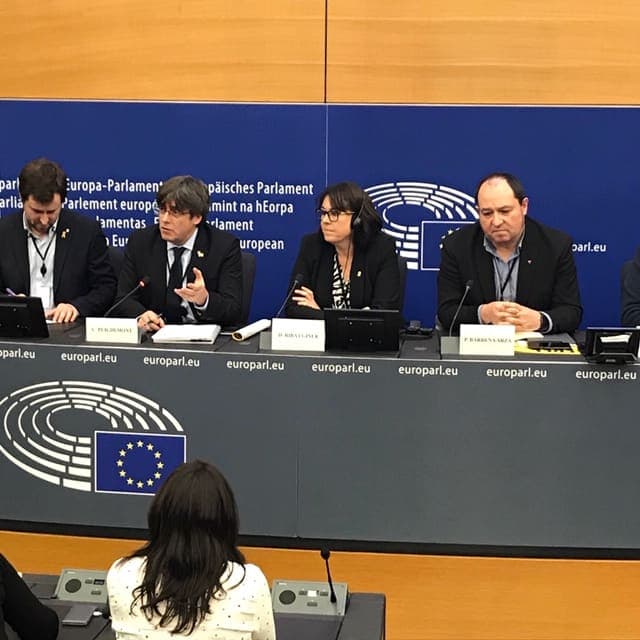
After months of legal battles, former Catalan President Carles Puigdemont and MEP Toni Comin have finally taken their seats in the European Parliament in Strasbourg. Upon their arrival, Puigdemont criticized the absence of Catalan politician Oriol Junqueras, who is imprisoned in Spain. “Spain no longer respects the rule of law,” he declared.
“If the European Union were truly a space of freedoms and rights, Oriol Junqueras would be with us today. He has the same rights as we do. In the European elections in May, he received one million votes,” Puigdemont said at a press conference in the European Parliament in Strasbourg regarding the fate of his former Catalan deputy prime minister.
After the 2017 Catalan independence referendum, Puigdemont and Comin fled to Belgium to escape the Spanish judiciary. Junqueras remained in Spain and was sentenced in October last year to thirteen years in prison for sedition and misappropriation of funds. Last week, that sentence was upheld on appeal.
Promotion
Junqueras, Puigdemont, and Toni Comin were elected as Members of the European Parliament in May last year, but they could not take their seats because Spain demanded they swear allegiance to the Spanish constitution in their own country. However, in December, the European Court of Justice ruled that the three Catalans enjoyed parliamentary immunity from the day their election results were announced.
Parliament President David Sassoli confirmed that Puigdemont and Comin were admitted to the European Parliament, but that Junqueras' mandate was terminated on January 3rd. This followed the decision by the Spanish electoral commission to revoke his mandate on that day. The Supreme Court confirmed this decision several days later.
Sassoli reiterated that, regarding Junqueras, he followed only the legal rules, which require the European Parliament to immediately take into account final decisions by national authorities. So far, this has not led to a heated debate in the parliament. The Parliament President ignored all questions and interventions on the matter.
There is a possibility that a ‘political debate’ over this ‘legal issue’ may still occur, since the European Parliament’s Legal Affairs Committee must endorse President Sassoli’s suspension decision. This committee can make decisions by simple majority. It is also expected that the revocation of the mandate will be submitted to the European Court of Justice.
Critics argue that European institutions and the European Parliament should have defended the inviolability of elected European representatives more robustly. They believe that Sassoli has too easily hidden behind legal formalities.