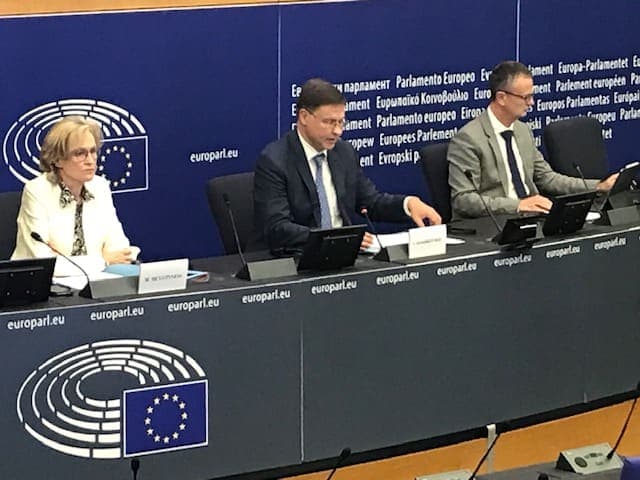
On Monday in Strasbourg, Members of the European Parliament from the Budget Committee and the Committee on Economic and Monetary Affairs hold their first recovery and resilience dialogue (RRD) with Commissioners Valdis Dombrovskis (Trade) and Paolo Gentiloni (Economy).
The commissioners are expected to update members on the billions spent from the Recovery and Resilience Facility (RRF), particularly regarding the achievement of milestones and targets, disbursed amounts including partial payments, and outstanding issues.
Just last week, a critical report from the European Court of Auditors on the expenditures from the recovery fund was published. According to the auditors, it is unclear to what extent the spending contributes to climate improvement or environmental goals. It had been agreed that the European billions would earmark over a third (37%) for these purposes. This is by far not verifiable, the report concludes.
Although the European Commission claims that the percentage even exceeds 40 percent, the Court of Auditors says this is overestimated by tens of billions.
The recovery and resilience dialogue is organized based on Article 26 of the regulation establishing the Recovery and Resilience Facility to ensure greater transparency and accountability in the implementation of the facility.
One of the main goals of the Recovery and Resilience Facility (RRF) is to contribute to European climate objectives and the green transition in EU member states. Unlike previous forms of EU expenditure, RRF funds are disbursed based on achieved milestones and targets, not on actual spending.
Among other shortcomings, the auditors found that given this financing model and the relatively short timeframe for RRF implementation, it is questionable whether all the money allocated for climate action will actually contribute to it. The auditors also found that some measures were less green than they appeared.