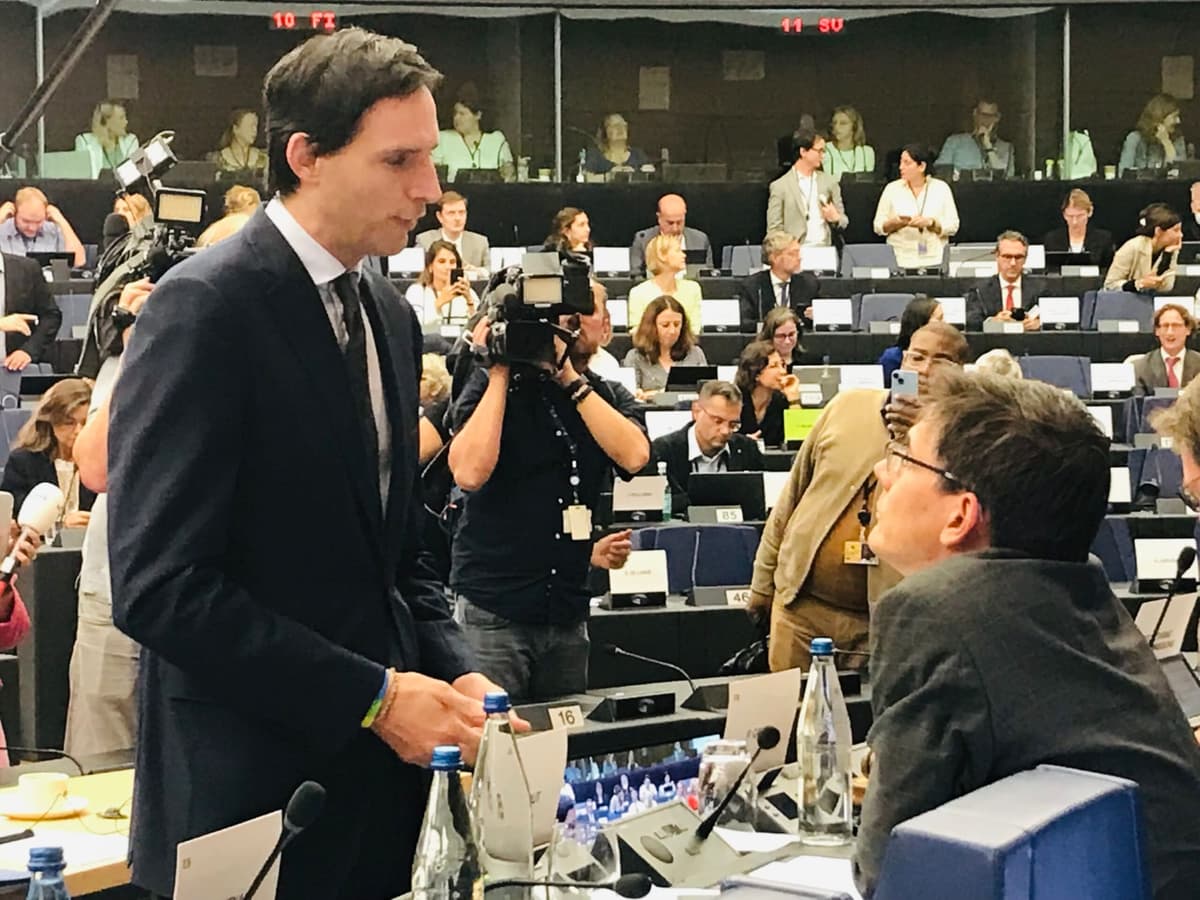
Hoekstra stated clearly that he intends to implement the environmental and climate agenda of his predecessor Frans Timmermans no matter what. In some areas, he even proposed expansion and acceleration.
During a three-hour interrogation, Hoekstra showed in answers to dozens of questions that he was well informed about the (significance of) the ongoing climate dossiers. He had been trained and thoroughly prepared in recent weeks by Diederik Samsom, the climate specialist and right-hand man of the departed previous Dutch commissioner Frans Timmermans.
For his presentation, Hoekstra employed the same charm technique his predecessor used upon entering Brussels: the CDA member responded to the many MEPs' questions in fluent English, French, German, and Italian. When hearing the questions, he hardly needed to use the translation service's earpiece. He answered the Dutch MEPs in Dutch.
Only his opening statement of fifteen minutes was read alternately in four languages from a document; he answered all subsequent questions from memory. It was noticeable that some EU politicians used their questions more to highlight their own party positions.
From the Party for the Animals (Anja Hazekamp) and GroenLinks (Bas Eickhout), Hoekstra received mainly critical, probing questions about (the lack of) his green climate profile. He was also accused that his political EVP/CDA friends are trying to strangle the Climate and Green Deal legacy of Timmermans.
Within the social-democratic S&D-PvdA faction, it is quite difficult that Timmermans’ portfolio has been split in two, that the Green Deal is assigned to a party colleague (Slovak commissioner Maros Sefcovic), but that the Climate part goes to a Christian Democrat. This is a change from the current political task division within the European Commission.
Sefcovic will be heard by the ENVI environment committee on Tuesday morning about his new Green Deal tasks. Because he has already been an EU commissioner for many years, his exam will be less difficult. He is, so to speak, already admitted. Moreover, his written preparation already showed he is realistic and experienced enough in European politics to accept that the center-right majority in Strasbourg wants to take a cautious approach with some Green Deal dossiers.
Both Hoekstra and Sefcovic repeatedly emphasized that the EU remains committed to the energy transition (away from Russian gas and oil) to solar and wind energy, and that there is 'no way back' for European agriculture. The agreements already made concerning the Green Deal are also fixed.
From Sefcovic's statements, it becomes clear that the European Commission is 'still considering' the costs and consequences of a substantial reduction in fertilizers and chemicals in agriculture, and that the 'strategic dialogue' of Commission President Ursula von der Leyen must first be started with the agricultural sector. Also, modernization of animal welfare 'is still in preparation.'
Hoekstra does not just want to continue the current European climate targets simply, but wants to set a sharper interim target. He wants to set the goal for 2040 at 90 percent less CO2 emissions.
Additionally, he showed a green profile by stating that subsidies and tax reductions for the use of fossil energy by large companies ('as in the Netherlands') must be phased out, and that shipping and aviation must also pay taxes for their air pollution.
Whether Hoekstra 'just barely passes with a meager six' or passes with flying colors on his admission exam will only be known Thursday afternoon. Then a vote on the new tasks of both commissioners will take place. Through a complicated procedure, both ultimately need a two-thirds majority.
Sefcovic will not have too much to fear. If the factions of United Left and the Greens vote against, and the liberals are divided, it is uncertain if S&D/PvdA will let him take a re-exam.