

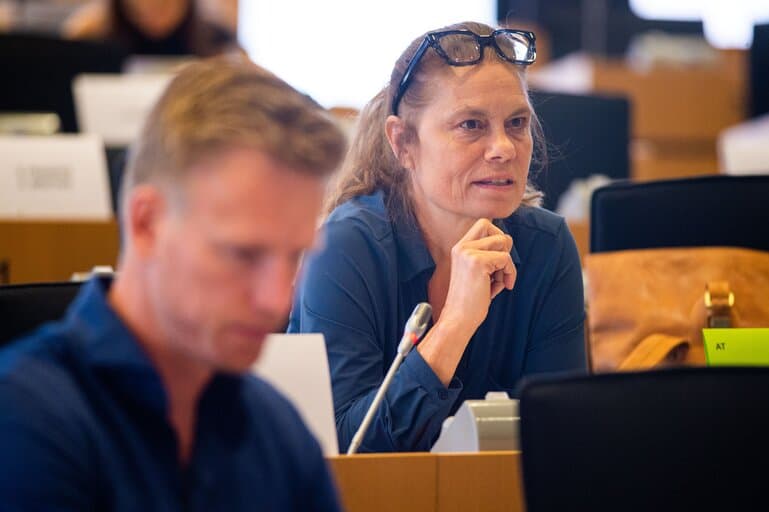
This is the response of the ENVI rapporteurs to the earlier proposal from European Commissioners Kyriakides, Sinkevicius, and Timmermans, and they will now negotiate with the EU ministers on this matter.
The presentation of Wiener’s report last week in Brussels triggered technical clashes with the AGRI Agricultural Committee, which tried to block the report until the last moment. Even Parliament President Roberta Metsola and the Committee of Presidents had to reprimand the agriculture committee for their ‘obstruction’.
It has now become clear that the proposal leads to a new political confrontation between the center-right and nationalist factions (led by EPP/CDA and ECR/SGP) and center-left groups (led by S&D/PvdA and Renew/VVD/D66).
Promotion
The final report summarized by Europolitician Wiener contains, on one hand, tightenings compared to the original Commission proposal and, on the other hand, compromises and expansions. For example, the ENVI committee wants the halving of chemical pesticide use to be extended to a complete ban on all dangerous, health-threatening substances.
In addition, the total ban proposed by the Commission in sensitive areas is relaxed. “At the same time, agriculture should not become impossible, so I have refined the definition of vulnerable areas. Furthermore, pesticides that are allowed in organic agriculture should be allowed to continue to be used,” Wiener said during her presentation.
However, spraying with chemicals is only allowed once all non-chemical alternatives and precautions have been exhausted. According to the Wiener report, this is an important part of the solution.
The ENVI Committee has also included recommendations to accelerate the approval of new environmentally friendly crop protectants, and that EU countries should receive support from EFSA in this regard. More use of natural substances is also now recommended.
For Dutch MEP Jan Huitema (VVD), who is co-rapporteur for the liberal Renew group, expansion and improvement of the earlier Commission proposal is particularly necessary on this point.
The liberals want to emphasize the rapid development of alternatives to chemical crop protection. This can happen in anticipation of the final legislation. The process has already started with the presentation of the report, and even the timetable is set: in July, the Environment Committee wants to align its position, and in September the SUR proposal will be presented to the plenary session.