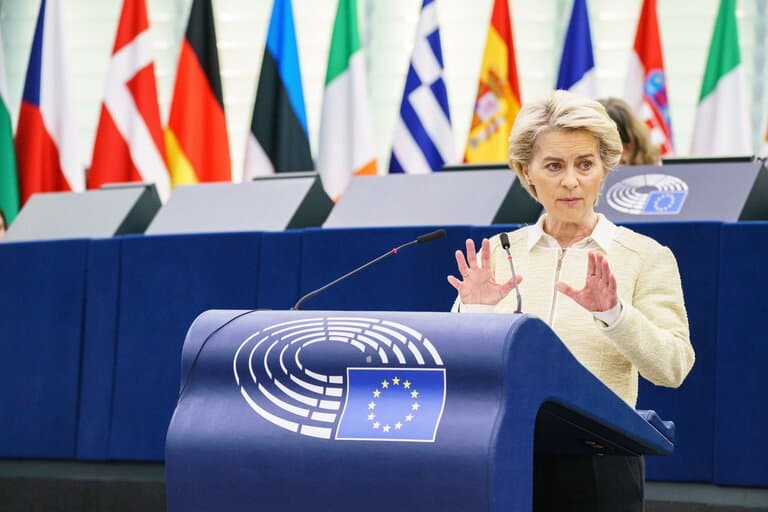
EU Commission President Ursula von der Leyen must answer this week in the European Parliament in Strasbourg for her decision to approve Poland's economic recovery package. She believes the European Union can resume payments of support funds to Poland now that the country has announced it will dismantle the controversial disciplinary chamber for judges.
However, the two Commission Vice-Presidents (Frans Timmermans and Margrethe Vestager) strongly disagree and voted against it. Three other Commissioners (Johansson, Reynders, and Jourová) did not vote against but also expressed their disagreement with Von der Leyen’s decision.
In the European Parliament, there is even talk of submitting a motion of censure. It is highly unusual for a Commissioner from one political group in the European Parliament (Christian Democrats) to be publicly reprimanded by the two other coalition groups (Social Democrats and Liberals).
A few months ago, a similar public split in the European coalition was threatened when the Christian Democrats pushed for a relaxation of the Climate and Environmental rules (Green Deal) in the new agricultural policy. Ultimately, Liberals and Social Democrats agreed to a very limited temporary easing, mainly because the war in Ukraine threatened global grain exports.
The Polish issue concerns payments from the large economic corona recovery plan of €23.9 billion and an additional €11.5 billion in cheap loans. This support package had previously been promised by the EU to Warsaw but was frozen under pressure from the European Parliament because the Polish conservative government was limiting judicial independence.
A disciplinary chamber is intended to appoint 'government-friendly' judges. This is against European law. Warsaw has recently partially rolled this back.
Since the outbreak of the Russian war in Ukraine, Poland has taken in more than 3 million Ukrainian refugees. These costs are only partially covered by new European subsidies, and Poland has now requested the disbursement of those corona funds. Other EU Commissioners and many MEPs believe that the principles of the European rule of law must not be compromised and do not want to link these two issues.
Von der Leyen acknowledges there is still much work to be done before the first payment can actually be made, she emphasized on Thursday in Warsaw after her discussion with Polish Prime Minister Mateusz Morawiecki.
Before the money is actually transferred to Poland, all 27 EU countries must agree, but this is expected to happen. In recent years, the heads of government have been unwilling to financially punish Poland and Hungary (by suspending existing subsidies), but they could no longer block this with the (new) corona funds.
MEP Sophie in ’t Veld (D66) says Von der Leyen is making the biggest mistake of her career, with disastrous consequences for the European legal order. “She is sending the signal that the rule of law is negotiable, that funds and values can be traded off against each other. From now on, the rulings of the European Court of Justice will be optional recommendations, without consequences.”
“For the umpteenth time, the European Commission is failing to do what it should: defend the rule of law. Instead, the Polish government is being rewarded for blocking unrelated dossiers and making a few superficial adjustments. A slap in the face to dismissed judges and to women, activists, and minorities in Poland who can no longer count on protection of their rights,” says the PvdA MEP Thijs Reuten.