

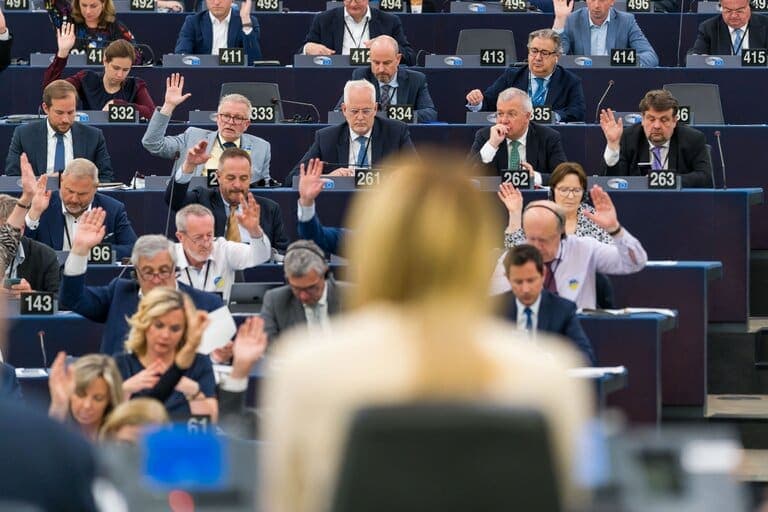
The European Parliament has not yet taken a clear position on the Climate Laws proposed by EU Commissioner Frans Timmermans after a chaotic vote. It is highly unusual for such important legislative proposals not to reach agreement at the very last moment during plenary sessions.
A significant financial component was rejected by a very narrow majority (11 votes). The proposal concerning the new ETS for emissions trading has now been "sent back to the ENVI committee," allowing the political groups to renegotiate it.
This also led to the postponement of votes on other elements (CBAM, Social Fund).
Promotion
In fact, the 'big climate debate' stumbled right from the very first vote, which had to determine how and when companies would pay extra taxes for their air and soil pollution. The "free ETS allowances" that many industries currently have were supposed to be phased out more quickly.
Some political groups want this to happen already in 2024, others a few years later, and some prefer no extra levies at all. These rules would also apply to land use (large livestock farms) and transport and shipping.
These additional taxes would constitute an important funding source for energy subsidies, home insulation, innovation, and the accelerated deployment of sustainable (solar and wind) energy. This funding source fell away because the new ETS was rejected.
Effectively, the European Parliament is primarily divided over whether the current energy crisis (caused by the Russian war in Ukraine) calls for scaling back environmental and climate requirements or accelerating them. This division was already evident this spring when, under pressure from the EPP, Green Deal requirements in agriculture were temporarily eased.
This time, the EPP Christian Democrats – despite earlier rejection in the ENVI environment committee – submitted amendments (to introduce taxes later, to exempt heat-leaking homes from penalties, to avoid banning the production of new petrol engine cars, etc.).
These EPP proposals were supported for "strategic reasons" by their liberal coalition partner Renew, and also received backing from the conservative ECR, the nationalist Identity and Democracy group, and the far right. As a result, Timmermans' package risked being "watered down," and the financing of other components threatened to disappear.
Therefore, social democrats S&D, the Greens, and United Left ultimately voted against what they called a too meager plan, while the far right voted against because the watered-down package was still deemed too ambitious.
The chair of the ENVI environment committee, French liberal Pascal Canfin, said after the votes that, in his opinion, the differences between the groups are not that significant. The rejected vote was essentially about whether to implement the "ETS tax rule" in the period 2024-2026, 2026-2028, or 2028-2030.
EPP deputy group leader Esther de Lange called on the S&D social democrats to reopen the issue for discussion in the committee and said that then the (not yet discussed) social fund could also be addressed.