

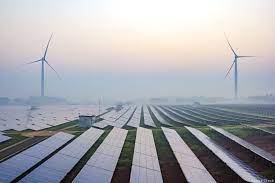
The European Parliament is expected to approve a new EU directive on renewable energy on Monday in Strasbourg. With rising energy bills and the threat of Russia cutting off gas supply, the transition from fossil energy to renewable energy seems more urgent than ever.
The renewable energy directive raises the initial target (32 percent by 2030) to 45% following the Russian invasion of Ukraine. It is expected that almost all factions in the European Parliament will agree to the European Commission's proposal on Monday.
For the Greens, the increased target of 45% is not ambitious enough, and an amendment proposes an even higher target of 56%. "I believe we can technically do even more than that 56%," said German Green MEP Jutta Paulus on Thursday to reporters during a Greens press conference.
Promotion
To support their ambitions, the Greens published a study on Thursday showing how the transition to renewable energy can be accelerated, including two scenarios illustrating how 100% renewable energy could be achieved by 2030 and 2040.
The Greens admit that both scenarios would be challenging but still believe it could be possible with strong political will.
In July, the Parliament’s Industry Committee voted to raise the target to 45% due to the energy crisis. According to the Greens, it is up to Parliament to show greater ambition.
With a difficult winter ahead, several countries, including Germany, Austria, and the Netherlands, are reluctantly turning to increased use of coal-fired power plants for electricity generation in response to Russia restricting gas supplies.
Moreover, countries like Poland have slowed their accelerated shift to renewable energy because of their heavy reliance on traditional coal.