

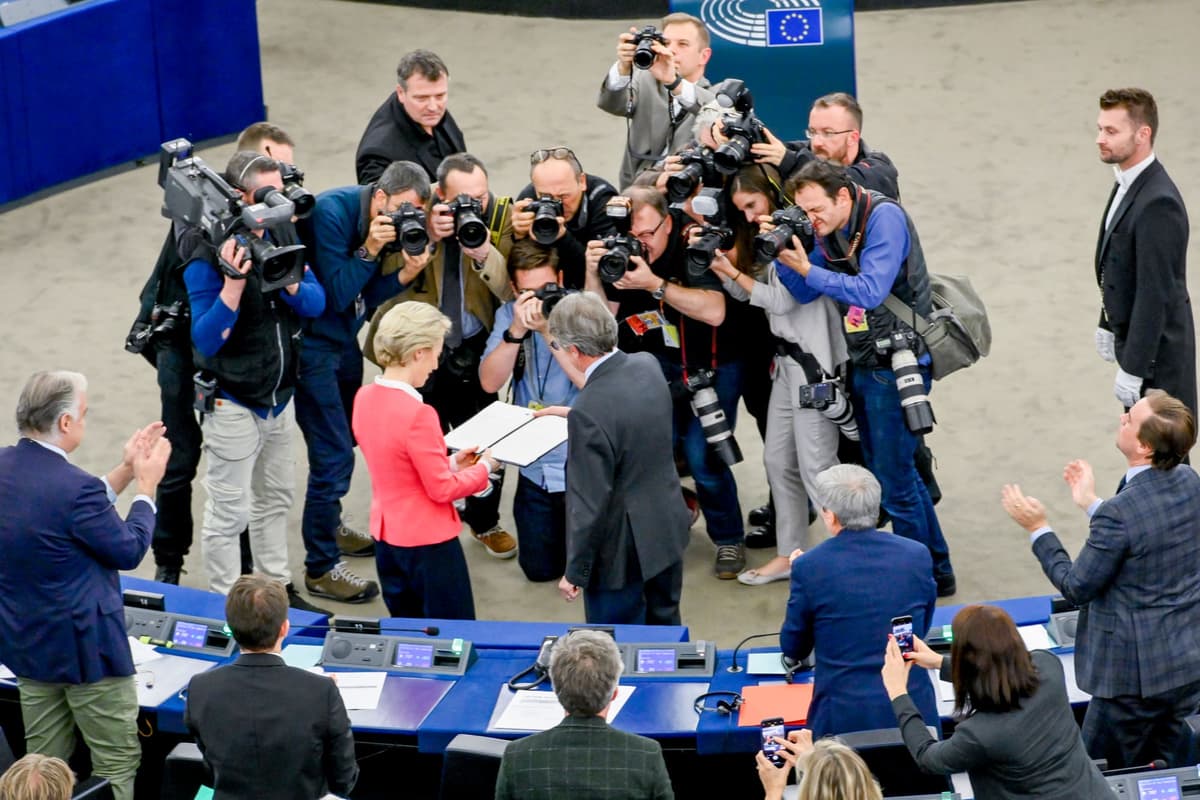
The European Parliament in Strasbourg has unexpectedly approved the new European Commission led by Commission President Ursula von der Leyen by a large majority. Her Commission received the backing of 461 MEPs, against 157 votes opposed and 89 abstentions. That 461 is significantly more than the 383 votes Von der Leyen received earlier this year in her own election as President.
At that time, her election was a close call, thanks to the support of a few dozen conservative Eastern European MEPs, despite abstentions and votes against by several dozen social democrats and liberals. That previous lack of support was mainly a sign of disapproval of the choice by the heads of state who had overturned the Spitzenkandidat system of the European Parliament. This time, the three coalition parties voted almost unanimously in favor, also gaining support from around twenty European Conservatives.
The Greens abstained from voting. They wanted to vote against the Commission due to the appointment of controversial French and Hungarian candidates, but also wanted to vote in favor because of the ambitious Environment and Climate policy. United Left, British Brexiteers, conservative nationalists, and right-wing extremists from Italy, Spain, and Germany voted against it.
Promotion
In her address to Parliament, Von der Leyen called the fight against climate change an existential challenge for this new European Commission. A 'Green Deal' to make Europe climate-neutral by 2050 is therefore urgently needed, and she named the Dutch Commissioner "Frans Timmermans as the right person to achieve this."
The Green Deal is our new growth strategy that should deliver new jobs, technologies, clean energy, less emissions, and global standards "in the service of citizens," according to Von der Leyen. For this, "massive investments are needed." Her "geopolitical" Commission will also strive for the "better global order that European citizens want." She wants Europe to be better able to provide a counterweight to the great powers USA, Russia, and China.
There are also many ambitions in the fields of digitalization and data protection. That Europeans' personal data ends up in the USA with every click was described by her as not a good situation. "It's about us setting the rules. That is an absolute priority."
Regarding migration and asylum, it is necessary to end the deadlock between EU countries, according to Von der Leyen. She pointed out the need to reform the asylum system, in a solidaristic way and with stronger external borders. "But Europe will always provide shelter to people who need international protection," she said.
She said she realizes that the announced policy plans can and must result in a genuine upheaval in many cases. Conservative and nationalist groups have already said that precisely because of this they voted against this Commission.
Looking ahead to the upcoming negotiations on the multiannual budget (2021 – 2027), Von der Leyen told her critics that today's Europe is no longer the same as it was seven years ago, and that European citizens may expect that the EU seven years from now will also no longer be the same as it is today.