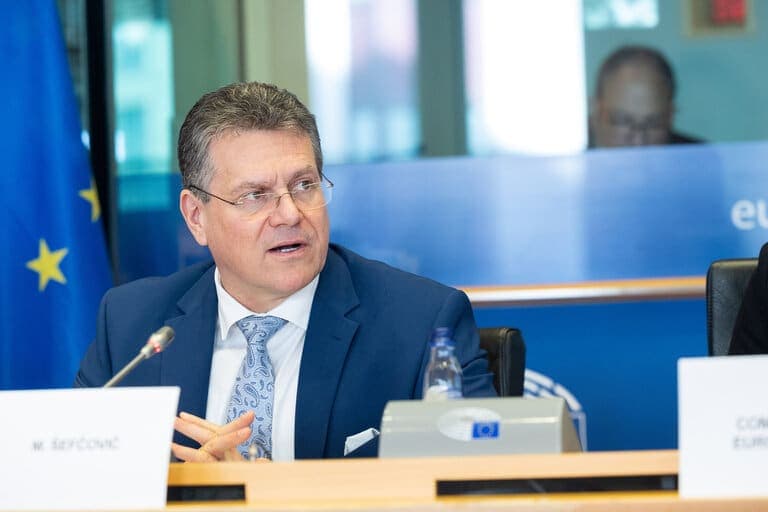
The new European Green Deal commissioner Maros Šefčovič immediately after his appointment stated that he does not intend to weaken or postpone the environmental and climate policies of his predecessor Frans Timmermans.
The Slovak social democrat did say that Brussels needs to improve communication with companies concerned about the costs of the climate transition. The Christian democratic EPP group in the European Parliament called the change in roles 'an opportunity'.
Šefčovič said it was an honour to further implement the European Green Deal. Europe aims to be climate neutral by 2050. The 57-year-old social democrat has been a member of the European Commission since 2009. Since the end of 2019, he has been one of the vice presidents of the Commission.
Šefčovič told journalists in Brussels: “We will not water down our ambition. However, I do believe that we need to respond faster, earlier, and more accurately to some of the genuine concerns that exist in certain sectors.” He did not elaborate on details.
The EU has faced opposition in recent months from some EU countries regarding the costs of climate measures. For example, Poland is taking Brussels to court (at least; that’s what they say in the election campaign), while centre-right EU politicians have campaigned against the Nature Restoration Law and the reduction of chemical substances in agriculture.
“In my opinion, the redistribution of powers is an opportunity,” says German MEP Peter Liese, EPP spokesperson of the environment committee. Šefčovič is expected to complete the remaining laws of Timmermans. Liese states he has come to know Šefčovič as a pragmatist. The EPP expects Šefčovič to take a closer look at the demands of the agricultural sector.
Šefčovič, as Green Deal commissioner and as first vice president, receives overarching powers above the ‘ordinary’ commissioners for Agriculture (Wojciechowski), Environment (Sinkevičius), Food and Health (Kyriakides) and Climate (Hoekstra).
The job description of the new Dutch commissioner Hoekstra is not yet finalized; next week the environment committee still has to approve his appointment. The fact that climate responsibilities of social democrat Timmermans appear to be transferring to Christian democrat Hoekstra does not sit well with the centre-left wing in Strasbourg.
Many MEPs see Hoekstra’s proposed appointment as an attempt by Von der Leyen to both maintain the Green Deal goals and at the same time accommodate criticism from (centre) right-wing groups about excessive environmental influences on the Common Agricultural Policy.
If Hoekstra does not secure the required two-thirds majority in the environment committee on September 11, Von der Leyen will face the choice of a broader task reshuffle within the Commission. This may be possible in the autumn because two other commissioners are stepping down mid-term and need to be replaced.
If the vote in Strasbourg comes down to one or two votes, Hoekstra could also choose to step down voluntarily.