

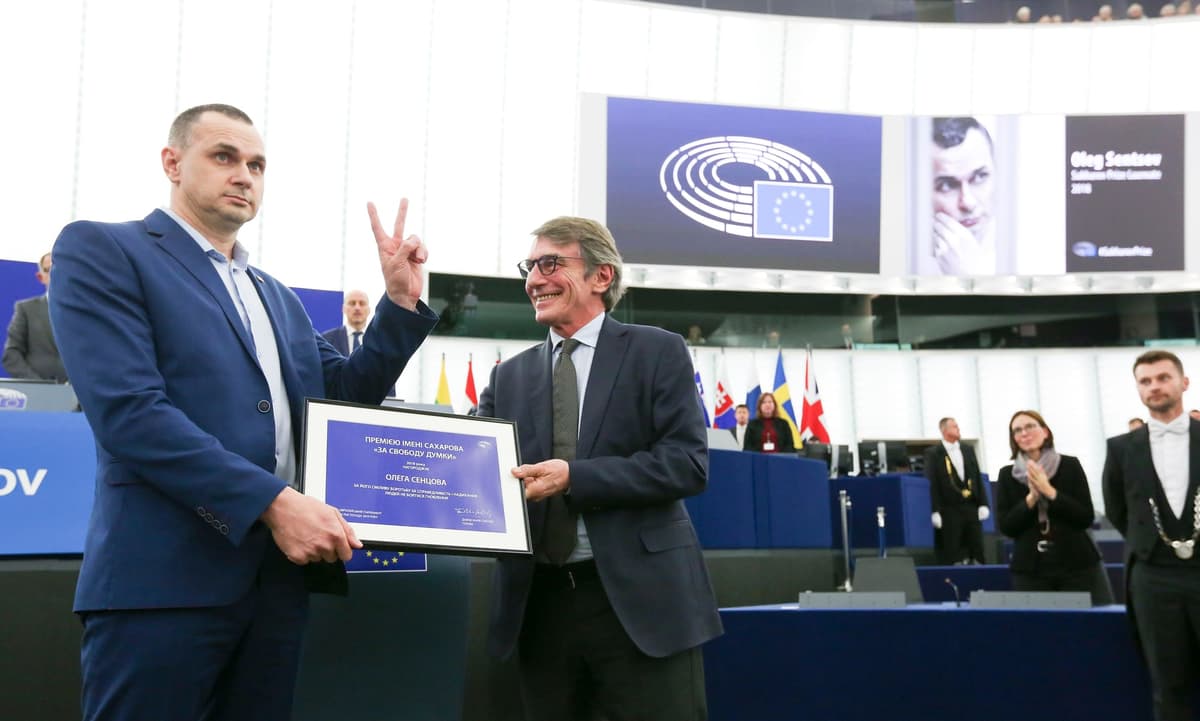
The Ukrainian filmmaker Oleg Sentsov received the European Union’s most important human rights award in Strasbourg following his recent release from prison in Russia. The European Parliament annually awards the Sakharov Prize for "freedom of thought." Sentsov was unable to collect the prize last year because he was still imprisoned at that time.
The critic of Moscow’s 2014 annexation of Crimea was sentenced to twenty years in prison in Russia in 2015 on charges of conspiracy. After his release in September as part of a prisoner exchange between Moscow and Kyiv, the Sakharov Prize was presented to Sentsov during a ceremony at the European Parliament in Strasbourg.
During a special ceremony at the European Parliament, Sentsov received a standing ovation. He said he considered the prize both an "honor but also a great responsibility" and dedicated it to "all other political prisoners in Russia." He ended his speech with "long live Ukraine."
Promotion
In a brief speech, Sentsov was particularly critical of Vladimir Putin’s Russia and very appreciative of the European Union. “I do not trust Putin. And you should not trust him either,” he addressed the Members of the European Parliament. “Russia and Putin do not want peace in Ukraine at all; they will deceive you!”
“The European Union certainly has its problems, but as we say in Russian, we wish we had your problems. Ours are much more complex. The ongoing corruption is still present, the Russian military aggression … The EU is a great institution and a good example for all of us.” According to Sentsov, Ukraine is the most pro-European country in the world.
This year’s Sakharov Prize was awarded to the Uyghur academic Ilham Tohti, who is imprisoned in China. The ceremony for Tohti in Strasbourg will take place on December 18.