

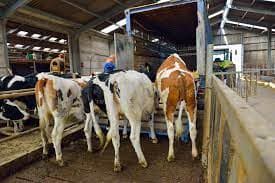
The new position of the European Parliament that road transport of slaughter animals should be limited to a maximum of eight hours is still far from being implemented. It will take at least several more years before any new legislation takes effect.
The prospects for swift improvements are indeed not favorable, as acknowledged last week by Luxembourg MEP Tilly Metz (The Greens), chair of the ANIT parliamentary inquiry committee.
Nonetheless, she expressed satisfaction with the eventual broad parliamentary support for the shocking final report and the 139 proposals for (some dozens of) stricter rules, and for (many dozens of) more voluntary “recommendations.”
Promotion
“Of course, we had wanted a lot of legally binding legislation. For example, a complete ban on animal transport. But with a maximum of eight-hour transports, we cover eighty percent of the export of slaughter animals (outside the EU – ed.). And that not only calves younger than ten days, but also other young livestock can no longer be transported, is also an improvement. And what about mandatory inspections that ground dilapidated ships and trucks?”
The currently advocated non-binding recommendations are intended to be part of new legislation (“Animal Welfare revision”) that Health Commissioner Stella Kyriakides wants to submit in 2023. Then the EU commissioners must take their own Commission positions on these 139 “recommendations.” After that, the 27 EU countries must do the same. It appears that the commissioners are “closer” to the position of the European Parliament than to the so far reluctant attitude of many Agriculture ministers.
Still, the European Parliament cannot count its chickens yet. Kyriakides has hardly any specialized officials or budget for this major legal revision at her department. Moreover, experienced EU politicians realize, now that the Parliament has taken an official position, that ministers may resort to delay tactics.
A lot will depend on how firmly Kyriakides stands her ground. She and Metz can at least expect support from Germany, Luxembourg, and the Netherlands. Those three countries put “stop the transport of livestock” on the EU agenda last year.
During the 2024 election year, trilogue negotiations between the European Parliament, the Commission, and the EU Council of Ministers must then begin. In many cases there will also be a transitional period that can last several years.
Last week, at the EU Agriculture Council in Brussels, many Agriculture ministers emphasized that their countries already do a lot to protect animal welfare during transport. They believe the EU should first act against those countries that do nothing about the abuses. Some ministers also said that new regulations should only be introduced if they are “based on scientific research.” In short, all “conditions” that already predict a difficult negotiation process.
Moreover, many of the 139 “recommendations” are by no means airtight. For instance, it is not yet defined how “relabeling” of slaughter animals can be prevented. A trader could transport the animals within the allowed eight hours as “breeding stock” to countries on the edges of the EU (such as Norway, Switzerland, Northern Ireland, Ukraine), which could then still resell them as slaughter animals to distant countries, including weeks-long transports on overcrowded, rickety livestock ships.
To the great dissatisfaction of Dutch MEP Anja Hazekamp (Party for the Animals), although the European Parliament agreed with the shocking final report on abuses in animal transport, in practice nothing is being done yet.
Hazekamp initiated the parliamentary inquiry two years ago. According to her, it remains at non-binding “recommendations,” and it remains to be seen if and when those, possibly further weakened, will become reality. That is why she voted no in disappointment…