The attempt by the EPP/CDA group leaders Manfred Weber and Esther de Lange to reject the ‘Timmermans law’ did not secure a majority amid loud applause (324 – 312 -12).
After votes in parliamentary committees recently ended in a tie three times, this time hesitant Renew liberals and EPP/CDA dissidents appear to have made the difference. Fifteen Christian Democrats voted against the proposal to reject the law, and 21 EPP members voted in favor of the law.
This time, a VVD/D66 compromise was on the table in Parliament that closely corresponds to the earlier deal among European environment ministers, further weakening the Timmermans law.
According to MEP Bas Eickhout (GroenLinks), further dilution of the Commission’s proposal became unavoidable due to significant (political) resistance. ‘The most important part remains: a law stating that nature must be restored. We can and must build on this.’
Parliament rapporteur César Luena pointed out that in the coming months, environment ministers and rapporteurs still need to agree on last-minute amendments. He also made clear that he will not allow new blockages by EPP/CDA in those trilogue negotiations.
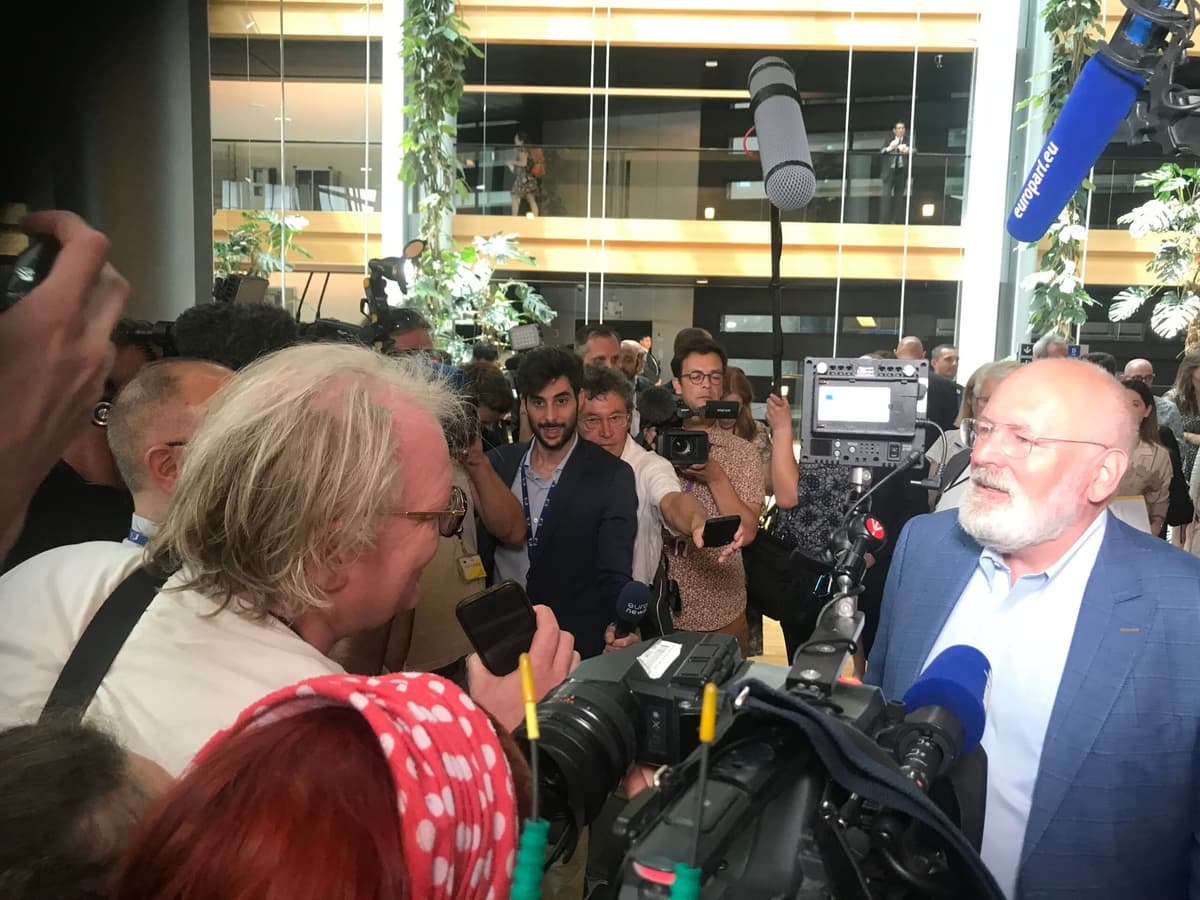
Climate Commissioner Frans Timmermans expressed satisfaction afterward that the European Parliament also agrees ‘that we need to do something about nature restoration.’ Immediately afterward, he held a well-attended press conference, where he emphasized (in fluent English, French, German, Spanish, Italian, and Dutch) that ‘nature can no longer wait.’
Timmermans also condemned how Weber and De Lange, ‘by walking away from meeting tables’ and ‘with false arguments and untruths,’ tried to undermine the democratic process in Brussels and Strasbourg. The CDA parliamentary leader called the result disappointing and spoke of ‘barely passing.’
She described pushing this law through as ‘not wise.’ However, she saw a silver lining in the fact that the EPP proposal for a ‘brake’ was ultimately included, should the nature restoration law threaten food production or housing development.
Bert-Jan Ruissen (SGP) called it ‘a good thing’ that a majority slightly weakened the proposal. ‘Still, we would have preferred the proposal to be rejected or further weakened. The EU rules for nature restoration remain too rigid, one-sided, and intrusive.’
According to Peter Van Dalen (Christian Union), many issues remain. In his view, the timeline is rigid and there is no room for flexibility. Van Dalen abstained from voting himself, as he acknowledged that the nature restoration law also contains many positive elements.