

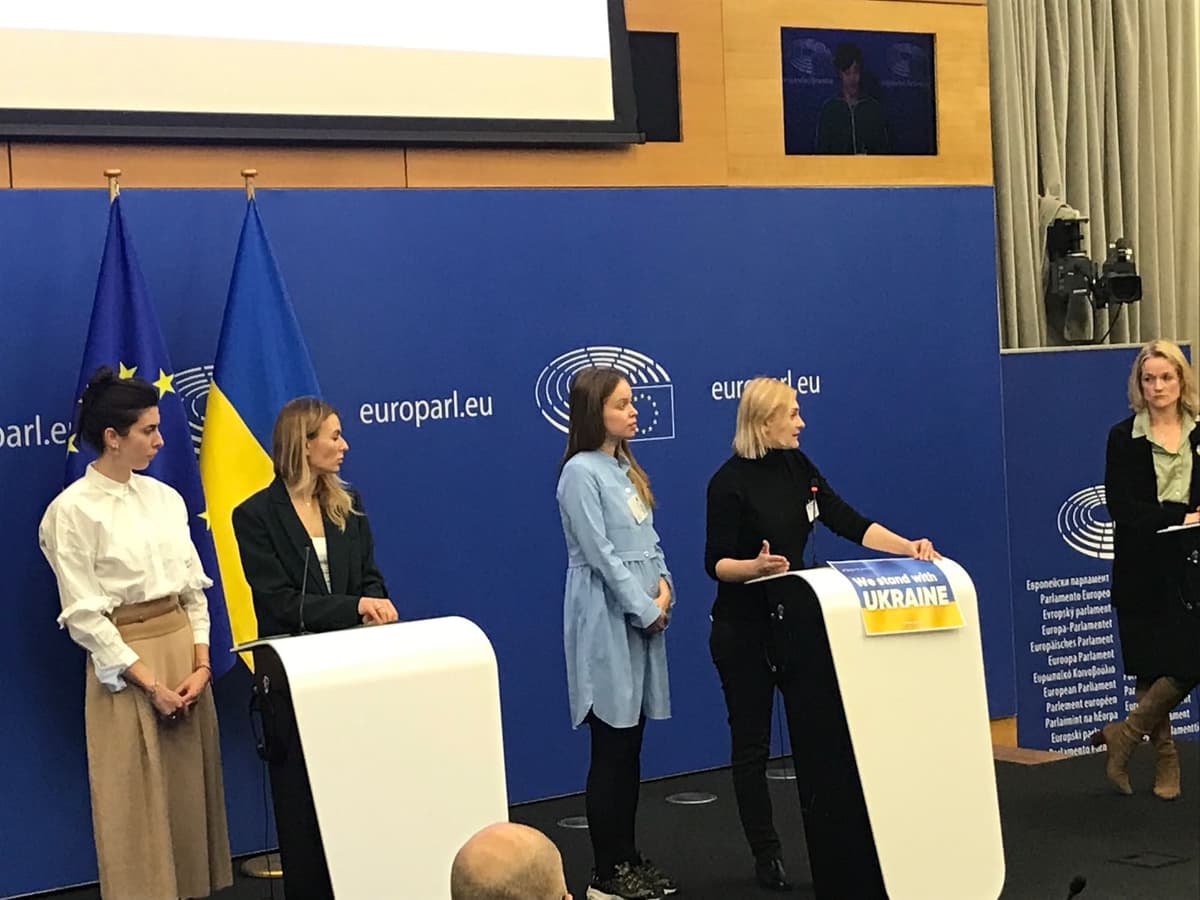
Ukrainian politicians have requested support from the European Parliament for a no-fly zone over their country. They hope to strengthen their air defenses against Russian bombings this way, but EU countries have (so far) refused.
The delegation from the Rada (the Ukrainian parliament) to the International Criminal Court in The Hague has also submitted the first evidence of war crimes against President Putin.
At a press conference in Strasbourg, the politicians emphasized that they need not only Stinger missiles against Russian jets, but also more air defense systems. They also highlighted the importance (‘for Europe itself’) of a no-fly zone, recognizing that NATO countries 'so far, currently' do not want this.
Promotion
MP Lesia Vasylenko pointed out that EU countries also initially said 'no' to halting the Russian Nord Stream 2 project and to disconnecting Russian banks from the SWIFT payment system. She is hopeful that the EU will realize that Putin’s war threatens not only Ukraine but the entire EU.
The Ukrainians warn that Putin’s apparent control over Ukrainian nuclear power plants means he may not even need to press the 'red button'; a mere ‘accident’ at a nuclear plant could suffice.
The delegation expressed satisfaction with recent boycott decisions and sanction measures by the European Commission and European Parliament, calling for a faster phase-out of Russian oil and gas. The MEPs also want serious efforts toward establishing an EU defense force that can operate alongside NATO. EU membership for Ukraine must be a serious option.
EU foreign affairs coordinator Josep Borrell said Putin’s war against Ukraine will leave a mark on history. 'Europe will have to be willing to pay the price if it wants to respond to Russia.' Furthermore, according to the Foreign Affairs Commissioner, this war will have long-lasting consequences that will influence European policy for years and decades to come.
MEPs welcomed the updated 'Strategic Compass,' which outlines the 'security situation' of EU countries after the Russian invasion of Ukraine. The Compass will guide the EU’s security and defense policy in the coming years. It is to be discussed this weekend by the heads of state and government leaders.