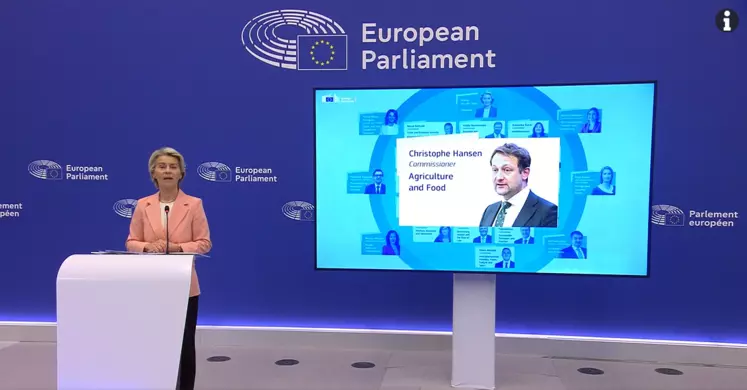
Von der Leyen emphasized that her new Commission remains committed to the Climate and environmental goals of the Green Deal; this vision towards more sustainability and biodiversity and less environmental pollution will also have to be integrated into other European policy areas. European industry will also have to cooperate in this, as has already become clear from the 'EU future vision' presented last week by former EU top official Mario Draghi.
Each Commissioner receives their own letter of assignment. The Dutchman Wopke Hoekstra (CDA) remains Climate Commissioner, also responsible for 'green zero-growth'. The Luxembourg politician Christophe Hansen has been nominated as the new Agriculture Commissioner. Although the agricultural sector in Luxembourg is small (0.2% of GDP and 0.8% of employment), Hansen is not unfamiliar with it. As a farmer's son and nephew of Luxembourg's Minister of Agriculture, Martine Hansen, he has a strong connection to the sector.
Hansen will be responsible for one of the most influential portfolios, as the Common Agricultural Policy (CAP) accounts for one-third of the EU budget. However, he will face a major revision of the CAP subsidies: moving from hectare payments to income support for individual farmers.
In the past six years as a Member of the European Parliament, he mainly focused on environmental issues, trade, and agriculture. Hansen played an important role in the negotiations concerning the national strategic plans under the CAP policy. In the coming years, he will need to engage intensively with the possible accession of agricultural giant Ukraine to the EU.
Von der Leyen has tasked Hansen with presenting a vision for the future of agriculture and food supply within the first hundred days of his mandate. He will need to base this on the recently presented 'outcomes' of the strategic dialogue initiated by Von der Leyen.
A major stumbling block could become the recommendation that 'environmental performances' in agriculture should be paid from a new European fund, and that payments for sustainability tasks should not be compensated from the already existing agricultural subsidies.
Besides Hansen's appointment, the new European Commission includes several other important positions, such as Maroš Šefčovič, who will be responsible for Trade, and Valdis Dombrovskis, who will take on the portfolio for Economy and Productivity. Furthermore, Hungarian Oliver Várhelyi will assume the portfolio for Health and Animal Welfare.
In the coming weeks, all commissioners must undergo a sort of 'interview' with the relevant specialized committees of the European Parliament. These committees cannot reject one or two candidates individually, but can only accept the entire nomination or reject it entirely. However, it is possible that Von der Leyen, as a result of criticism or doubts, may still adjust parts of the portfolios of the new commissioners.