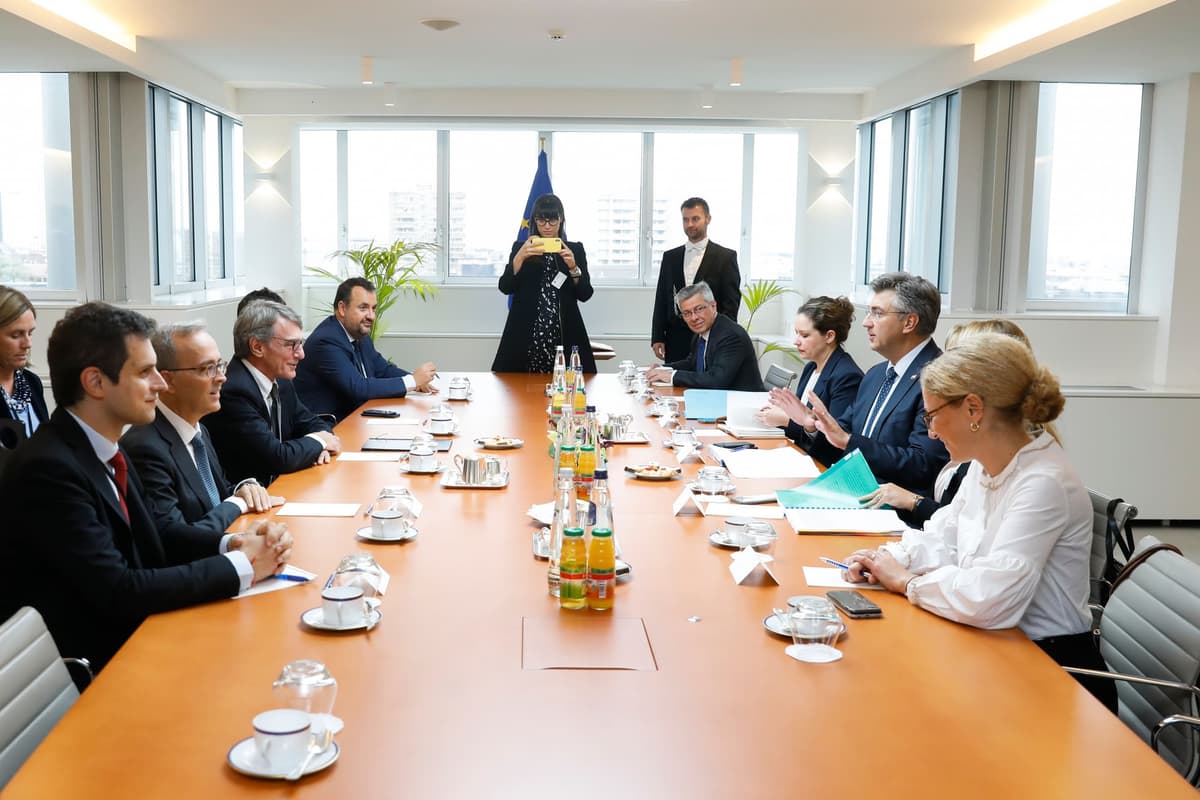
Croatian Prime Minister Andrej Plenković made it clear that Croatia, the newest EU member, wants to join the Union's inner circles as quickly as possible and become part of the visa-free Schengen zone. Croatia also aims to adopt the euro as its currency as soon as possible.
Plenković spoke on Wednesday in Zagreb with a group of 60 Brussels-based journalists on the occasion of the inauguration of the Croatian Presidency of the Council of the EU. Croatia is taking over the rotating presidency from Finland.
Apart from the priorities of the Croatian presidency highlighted in recent days, Plenković stressed that his country has two important national goals: accession to Schengen and to the eurozone.
There is a great deal to do on the European front in the coming half year. Of course, there is Brexit. The United Kingdom was to leave the EU on February 1, but by the end of this year a trade agreement must still be in place between London and Brussels. Additionally, a Balkan summit will be organized in the Croatian capital Zagreb, which will deliberate on the expansion of the European Union. Croatia was the last country, the 28th, to join the EU in 2013. Expansion including Montenegro and Albania is currently being blocked by France and the Netherlands.
Other important subjects are establishing a multiannual budget until 2027, managing the migration issue, and rebuilding a climate accord aimed at achieving emission neutrality by 2050. Croatia itself wants to join the Schengen zone and bid farewell to the national currency kuna; the euro must be adopted by 2024 at the latest.
Croatia recently elected a center-left president. However, right-wing nationalism remains strongly present in the country, which will hold the presidency of the European Union in the first half of 2020. Last Sunday, Croatia held presidential elections. In the second round, social-democratic candidate Zoran Milanovic (53) defeated the conservative incumbent Kolinda Grabar-Kitarovic with 52.7 to 47.3 percent. His five-year term begins in February.
After his election victory, the new Croatian president sought the right words. He wants to be a head of state above parties, for all 4.5 million Croats, of a liberal, democratic, and pro-European country. He does not want to conduct politics behind closed doors. He does not want to talk about the past anymore and will act strictly within the constitution, said Milanovic.
All of this should, of course, have happened in Croatia a long time ago. This list shows how much Croatia still lacks, with terms such as corruption, nepotism, unpunished war crimes, and poor relations with neighboring countries. There is a trade war and bitter debate with Serbia about the extradition of each other's war criminals. Slovenia long blocked Croatia’s EU membership due to fishing and territorial disputes.
One of Croatia’s biggest corruption cases recently reached a provisional conclusion. Former Prime Minister Sanader received a six-year prison sentence for accepting ten million euros in bribes.