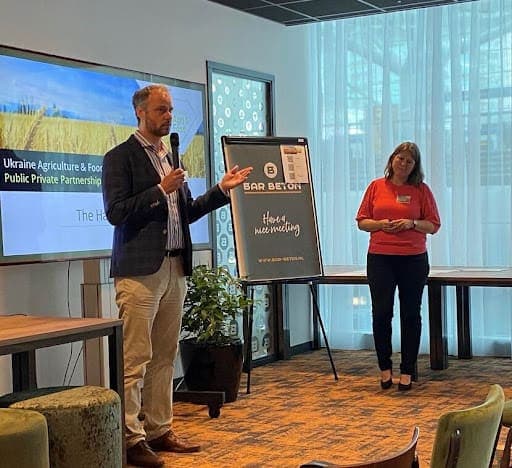
“The course of the war is hard to predict and that obviously has a great impact on what happens. For the Dutch agricultural sector, it is now difficult to determine what can be done. You can build a greenhouse or barn now, but if it is subsequently hit by an airstrike, that is pointless,” says Nuijten (45) in an interview with Agroberichten Buitenland.
“The war has changed everything. Themes such as sustainability and animal welfare are and remain important, but when the war began, Ukrainians had other concerns. Now there is simply a need for tractors and other machinery, various basic necessities to survive and to keep businesses running.”
“This war will end one day, that is certain. So the Dutch business community must show itself now as well. If you wait too long, you can miss opportunities. We need to help Ukrainian businesses survive. And during the reconstruction, we can focus on sustainable and animal-friendly solutions. If we invest in that, it will definitely pay off,” said the Dutch agricultural consul.
At the end of this year, official negotiations will begin in Brussels about Ukraine’s accession to the European Union. It is likely that the country will be admitted earlier than the ten other European countries that have long been requesting EU membership. This will have far-reaching consequences for European agricultural policy. Ukraine’s agricultural capacity is about three times larger than that of Poland, which until now has been considered a major agricultural country within the EU.
Until a few years ago, the Netherlands took a reserved stance towards Ukraine. According to Nuijten, this was partly because the country did not comply with EU laws and regulations in several areas. “For the agricultural sector, this concerned, for example, the use of genetically modified seeds. There were also issues around the export of chicken meat and animal welfare. Those circumstances have now changed.”
Nuijten is glad that the perception of Ukraine among the Dutch has shifted. Now the Netherlands stands at the forefront in Europe in helping Ukraine. Next week (October 1–6), a delegation from Ukrainian “green” educational institutions will come to the Netherlands to prepare cooperation in the field of “regenerative agriculture.”
The visit is a follow-up on earlier cooperation, earlier this year, between WUR and HAS with Ukrainian knowledge institutions and an earlier digital networking meeting by the Ministry of Agriculture, Nature and Food Quality (LNV).