

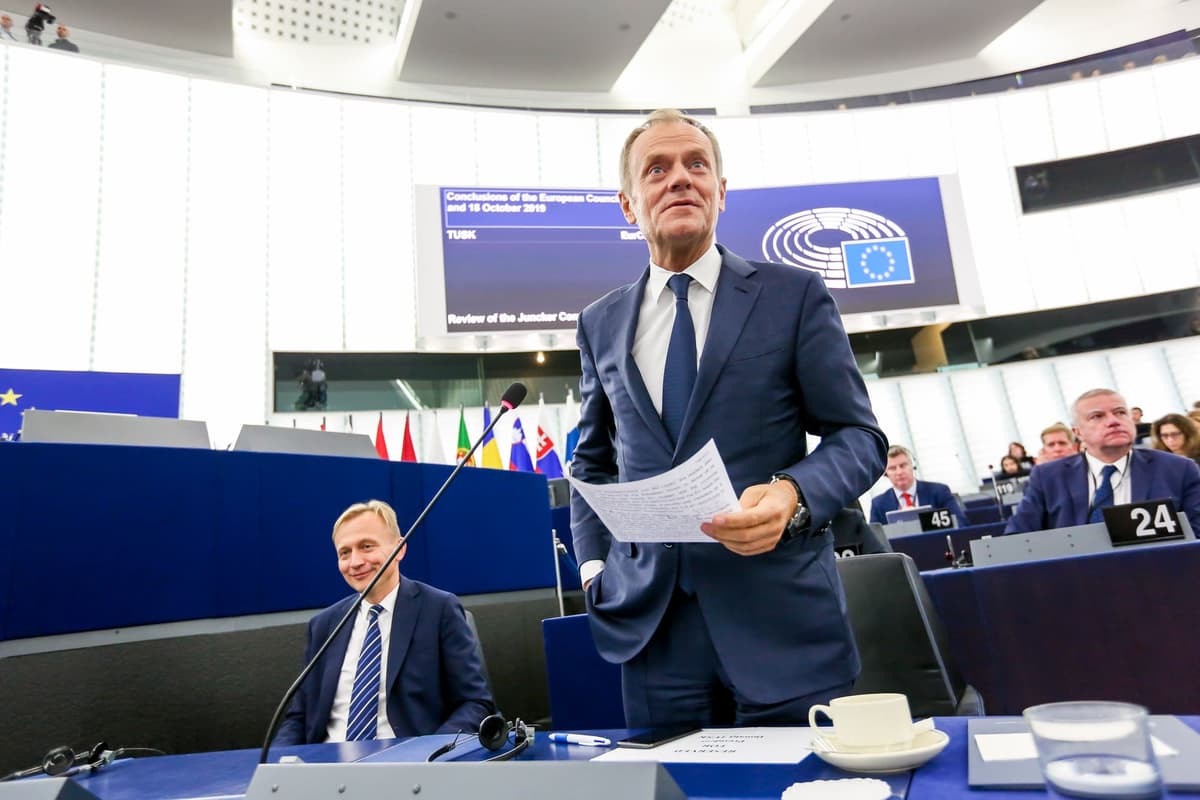
The European Union is granting the United Kingdom, as expected, an extension of up to three months for Brexit. This was announced by EU President Donald Tusk. The British can also leave earlier than January 31 if the withdrawal agreement is approved by the House of Commons sooner.
The EU ambassadors of the other 27 member states agreed on Monday morning to the three-month extension requested by British Prime Minister Johnson. A hard Brexit without a deal on October 31 is thereby definitively avoided.
The French government had earlier preferred a shorter extension, but nevertheless agreed to three months. The EU requires firmly that the agreement on the terms of departure, which was reached with Johnson this month, must not be reopened.
Although the French government objected to a three-month extension, the current 'but it can be earlier' apparently suffices for Paris. If the British parliament still agrees on a withdrawal arrangement, Brexit can become a fact on the first day of the following month, for example on December 1.
Promotion
The EU seems to assume that a no-deal Brexit on October 31 is off the table. The Brussels decision provides British Prime Minister Boris Johnson hope of holding new elections this year, provided he gains support from part of the opposition.
Later today, Prime Minister Johnson wants to submit his proposal again to hold early parliamentary elections. The opposition in the House of Commons will only cooperate if a damaging no-deal Brexit is definitively ruled out and if the House has approved all corresponding British laws.
Those 'corresponding laws' could still cause major problems because, for example, it is not yet clear what kind of trade agreement between Great Britain and the EU will be arranged. Those negotiations could take three years. Especially the Labour opposition believes that part of the British economy and trade must remain connected to the EU in some way.
Moreover, two opposition parties, the LibDems and the Scottish Nationalists, have submitted their own proposal for early elections. This would place control over these elections in the hands of parliament rather than the Conservative government. That proposal can only gain a majority if several dozen dissident Labour politicians support it. Within Labour, as well as the ruling Conservative Party, politicians are deeply divided over whether or not to terminate EU membership.
In theory, it is also still possible that these two parties and the Conservative Party come to a joint compromise, but given the current political differences and hostile attitude between the British parties, that seems unlikely.
Recent opinion polls show that any damage to the Conservative Party is much smaller because Prime Minister Johnson 'has achieved something after all.' Labour, on the other hand, is experiencing significant losses as many opponents of Brexit will turn to the LibDems, Scottish Nationalists, or the Greens, who may campaign to stay within the EU.