

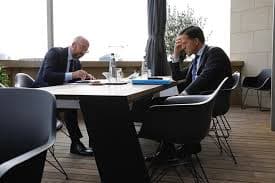
The Belgian politician says that the European heads of government can already make a decision on his succession at their July meeting, if necessary temporarily. This places the European heads of state in a dilemma, because at that time—so shortly after the elections—there will be no clarity about the appointment of other key EU positions.
Also, a new European Commission must be composed in the autumn, including the chairmanship. In Brussels corridors, it is heard that the German Christian Democrats aspire to a second term for Ursula von der Leyen. Then the puzzle emerges of who (which country, which party) may provide a Commissioner, who will become president of the European Central Bank, who will be the new NATO chief, and so forth.
That the Belgian liberal Michel is already informing the EU heads of state that he will step down (and must be replaced) puts the EU Council under great pressure. The European prime ministers will want to prevent Hungarian Prime Minister Viktor Orban from actively interfering with various EU appointments in the second half of 2024. Orban is considered a troublemaker within the EU. Hungary is scheduled to hold the EU presidency in the second half of 2024.
Promotion
Five years ago, it was French President Macron, German Chancellor Angela Merkel, and Dutch Prime Minister Mark Rutte who ultimately decided how the European top posts were allocated. That resulted in Charles Michel becoming chair of the EU Ministerial Council, also called 'President of the EU'.
At that time, it was whispered in Brussels corridors that Rutte could have taken that role himself but chose instead to continue his premiership in the Netherlands.
Rutte has since stepped down and currently serves only as caretaker Prime Minister in The Hague. Recently, he announced his interest in becoming Secretary General of NATO. There are two other candidates for this top position. A decision on the succession of the current SG, Jens Stoltenberg, has already been postponed twice. It is unknown whether Rutte is interested in other international positions.
Michel did not want to comment in the Belgian media on whether his candidacy for a parliamentary seat also means he is interested in other European top positions or whether he wants to succeed his party colleague Didier Reynders as EU Commissioner from Belgium.