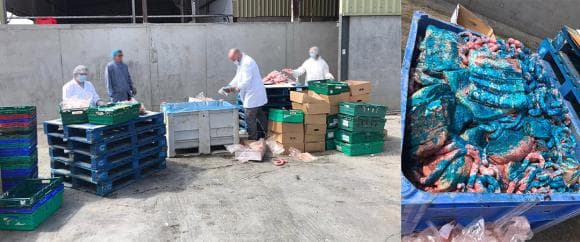
In a joint operation by Interpol and Europol targeting fraud in the dairy and meat trade as well as dangerous medical products, more than 12,000 tons of goods have so far been seized and over four hundred fraudsters and criminals arrested.
Across Europe, in recent months, seizures have included batches of suspected horsemeat and apparently forged horse passports at several slaughterhouses throughout the EU, including in the Netherlands.
Europol calls fraud involving horsemeat a “dangerous criminal trend.” For this reason, law enforcement agencies dedicated a separate project to it within the international OPSON operation. The Netherlands, Belgium, and Ireland led this effort with support from the European Commission. Documents for more than 157,000 horses from eight countries and around 117 tons of horsemeat were inspected.
As a result, more than 17 tons of horsemeat were seized from various slaughterhouses in Belgium, Ireland, Italy, Spain, and the Netherlands. Inspections of slaughterhouses in various countries revealed that about 20% of the foreign passports used for these horses showed signs of forgery.
In cooperation with (food) authorities from 83 countries, European agencies, and private parties, Europol and Interpol carried out 26,000 inspections to uncover food fraud. This resulted in the confiscation of 12,000 tons of illegal and harmful foodstuffs valued at €28 million.
Almost half of the confiscated products, 5,000 tons, were animal-based products (dairy and meat), followed by alcoholic beverages, primarily wine (2,000 tons), grain products, derivative products such as olive oil, coffee, tea, and spices.
The trend of more people buying products, including food, online presents a risk. Potentially dangerous food items may be involved, warn Europol and Interpol. The COVID-19 pandemic could also be contributing to an increase in poor-quality foodstuff circulation, the law enforcement agencies caution. This is also reflected in a report Europol published in April.
The investigation also led to the discovery of 320 tons of smuggled and low-quality dairy products. National authorities also confiscated spoiled milk and cheese that posed a public health risk. A Bulgarian investigation at an unregistered storage facility uncovered seven positive samples for starch and E.coli. The Bulgarians tracked down 3.6 tons of unsafe dairy products intended for processing into processed cheese.
Under Greece’s leadership, several countries tracked down 149 tons of tampered olive oil. Eighty-eight tons were intercepted in Albania, Croatia, France, Greece, Italy, Jordan, Lithuania, Portugal, and Spain. At a company in Italy, it was discovered that not all produced olive oil was recorded in the company’s books. This resulted in the seizure of 66 tons of olive oil.