

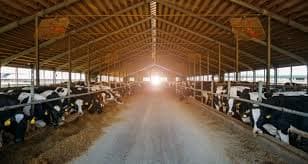
The European Commission initially wanted to include almost all livestock farming, while the Agriculture Committee of the European Parliament wanted to exclude livestock farming entirely. In the trilogue agreement now reached, the negotiators have significantly raised the thresholds for livestock farming.
The rules will apply to agricultural businesses from 350 large livestock units for pigs, 280 for poultry (300 for laying hens), and 380 for mixed farms. Extensive farms and small-scale livestock farming for household use will be excluded for the time being.
The new rules will be introduced gradually, starting only from 2030. By 2026, the (new) European Commission must assess how best to address air and groundwater pollution caused by livestock farming and agricultural production, with particular attention to cattle farming.
Promotion
The new rules also require polluting companies to keep records in a public register of the raw materials they process and the waste and pollution their operations emit into the environment. Neighbors can then file damage claims against them. Each EU country must incorporate this into its own legislation. Penalties must also be significantly increased in many member states.
Politicians in Brussels have periodically tried in recent years to tackle pollution caused by agriculture. With the environmental and climate laws from the Green Deal and the new agricultural policy, a strong start has been made, but lately that greener course is under pressure.
The agricultural sector is the third largest emitter of greenhouse gases in the EU but could become the largest polluter as other industries become 'cleaner' more rapidly.
According to the European Environment Agency, emissions from agriculture have decreased by only 3 percent between 2005 and 2021. This is comparable to a 7.6 percent decrease in the transport sector and a 31 percent reduction in emissions from homes and buildings.