

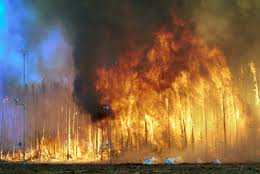
The persistent drought is causing not only an increasing number of forest fires in forest and nature areas, but also more and more vegetation fires in rural areas across several Central European countries. Meteorologists predict a long and dry summer. Parched soils are also leading to smaller harvests.
Fire brigades in northern Germany have by now called for help from local farmers in East Frisia: they are asking farmers to assist with their equipment and vehicles. The first forest fires have already occurred in the grasslands of East Frisia. Vegetation fires are not easy to extinguish and place high demands on the fire service.
Moreover, not all fire trucks are suited for off-road, and the water supply is a huge problem: there are usually no fire hydrants. Here, firefighters are requesting support from farmers and contract workers. Driving around outside paved roads is usually no problem with their agricultural machinery, and furthermore, the farmers’ manure tanks can transport enormous amounts of water. The farmers can pump water from puddles and lakes and streams and then transport it directly, which the fire service can then use to extinguish fires.
Promotion
Large parts of Switzerland and Austria are already experiencing historic drought. This also raises fears for the next grain harvest. On Friday, the Geneva region broke the record for the number of consecutive days without precipitation in spring since measurements began in 1864. The last time it rained there was March 12.
With this, Switzerland is not far from the absolute drought record of forty-one days, set in the winter of 1896. The groundwater shortage is twice as high as the average of the past thirty years. If it does not rain in the coming two weeks, Swiss and Austrian farmers will have to start counting their losses.
The German Raiffeisen Association (DRV) is also already anticipating lower yields. DRV has slightly lowered its forecasts compared to the previous month. Increasingly, reports are also appearing in Polish media about agricultural organizations warning of disappointing harvests and thus higher food prices, as Polish farmlands lie parched.
In the Netherlands, irrigation is already taking place in more and more agricultural areas. The Dutch cabinet expects problems due to drought again this year. In some parts of the country, especially on high sandy soils, significant drought conditions already prevail.