

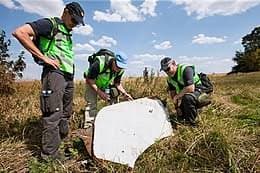
Russia has tried in various ways to hinder, influence, and sabotage the international JIT investigation into the downing of MH17. These new revelations come just days before the start of the MH17 trial against four suspects accused of shooting down the Malaysian passenger plane.
Monday marks the first day of the trial. Four suspects have been summoned: three Russians and one Ukrainian. All three Russians have ties to Russian secret services. They are charged with murder and causing the plane crash, resulting in the deaths of those on board.
The Russian obstruction was partially known, but has been further exposed through new revelations by the Dutch newspaper De Volkskrant. The paper especially uncovers new details about how the Russian military intelligence service GRU operated, not only during the initial years of the investigation but also quite recently. Exactly when the disruption began is unclear but likely just days after the tragedy on July 17, 2014.
Promotion
At that time, the Dutch Safety Board (OVV) immediately began its own investigation into the possible cause. This body is always involved in investigating major accidents in the Netherlands. The Dutch investigators established contact with their Russian counterparts, the Russian Interstate Aviation Committee (MAK), with whom relations were good.
After a few days, however, it became apparent that the MAK investigators had been replaced by a five-member state commission, led by a team leader who had previously worked for a Kremlin security service. Presumably, the Russian government sought to gain control over the investigation.
It has become clear that the Russians’ focus on the OVV may have been misplaced after Russia opposed any form of international prosecution of potential perpetrators in the UN Security Council, including via a UN tribunal. When the Netherlands and Australia, alongside Malaysia, Belgium, and Ukraine, jointly took charge of the JIT criminal investigation, Moscow reacted furiously. To this day, President Putin accuses Dutch Prime Minister Rutte of excluding Russia from the investigation.
The Joint Investigation Team (JIT), which conducted the criminal investigation, concluded after extensive and prolonged research that the Buk missile used originated from a Russian military unit. For this reason, the Netherlands and Australia ultimately held Russia liable for shooting down the aircraft.
A few weeks after the disaster, Malaysian pilots came to the Netherlands to translate conversations held by their Malaysian colleagues aboard the doomed plane. During that same period, two members of the Russian military intelligence service GRU were in the Netherlands, as was later revealed. One of these members is the leader of the unit. What the two were doing in the Netherlands is unknown. "But a connection with MH17 is obvious," a source from De Volkskrant says.
Six months later, two former GRU members appeared to be part of the Russian state commission collaborating with the OVV. One of them is a Russian army general who publicly declared shortly after the crash that it was unlikely that the plane was downed by a Russian Buk missile. The Dutch military intelligence service MIVD observed the two when they were in the Netherlands for meetings with investigative teams from other countries. After each meeting, the two investigators called a phone number linked to the Kremlin.
There are more examples of attempts to influence the investigation and investigators. For example, members of the OVV and Dutch police officers were unusually often approached by young women during a visit to Ukraine—sometimes even in Dutch—near their hotel. Their hotel rooms were also cleaned unusually frequently, sometimes up to three times a day. Private phones of military police officers were found to be infected with malware after returning to the Netherlands.
Furthermore, at least one hacking attempt at the OVV is known, attributed to the hacker group Fancy Bear, linked to the GRU. De Volkskrant now reveals that the GRU members who tried in 2018 to infiltrate the OPCW office’s computer network in The Hague had first been in Rotterdam near the National Public Prosecutor’s Office. That is where the criminal investigation into the MH17 disaster is conducted.
The MIVD seized equipment from the GRU members. On a laptop, the service found information showing that the team had been in Malaysia in 2017 to set up an operation against the Malaysian investigation team. The Dutch investigators are convinced that the Russian interference and sabotage attempts were unsuccessful. The investigation became more complicated, with noise and distrust, but these did not affect the conclusions, the investigators told De Volkskrant.