

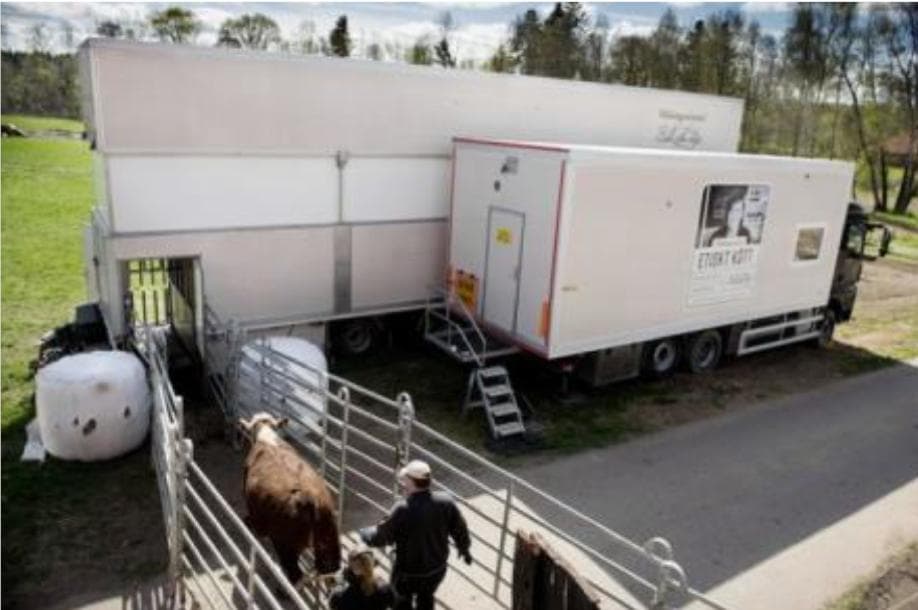
In the Austrian parliament, politicians from the conservative-green governing coalition have submitted amendments to make mobile slaughtering of livestock possible on farms everywhere.
Over the past year, some Austrian states have conducted trials with this. These have been so successful that it is now allowed everywhere. However, some hygiene laws for small farms need to be adapted for this.
“With this legislative initiative, we ensure fewer animal transports and less stress for farm animals before and during slaughter. In this way, we improve animal welfare and create new sales channels for farming families,” says ÖVP agriculture spokesperson Olaf Strasser.
Promotion
In the states of Upper Austria, Styria, and Tyrol, mobile slaughterhouses are already (partially) in use. For the first time in Austria, stress-free slaughtering will soon be possible throughout the country.
Additionally, there will be a regulation for slaughtering in the familiar living environment of the animals, such as in the pasture, pen, or near the feeding station — following the example of Switzerland. This also includes slaughtering in mobile slaughter units, which for example have long been permitted in neighboring Germany.
In the Austrian state of Upper Austria, a pilot project for mobile slaughter units was recently presented. A large number of Bio Austria farmers have long requested a legal framework for animal-centered, stress-free slaughter in the familiar environment.
Bio Austria hopes that the welfare-based pilot project will serve as a model and that other states will follow Upper Austria’s example. Ultimately, this could lead to a nationwide legal framework enabling stress-free slaughtering in the familiar environment.
The phenomenon of mobile slaughterhouses is not entirely new in the Netherlands either. Slachterij Dokkum started a year ago with a mobile slaughterhouse for cows. They focus on animals that cannot be transported alive but are still suitable for slaughter. These animals are currently removed and destroyed, even though the meat can still be consumed. Their slaughter vehicles are also deployable for animals that have always lived in the wild.
In the Netherlands, agricultural and food expert Ruud Pothoven already conducted a feasibility study seven years ago on the possibilities of mobile slaughtering in the country with his company Innohow.
"At that time, the moment wasn’t ripe yet, but since then many more small-scale and sustainable pig farms have emerged. It also helps that mobile slaughterhouses are active in EU countries like Germany, Sweden, and France. The experiences there are positive. Legislation and technology no longer stand in our way; a slaughterhouse on wheels is allowed and possible," he said recently.