

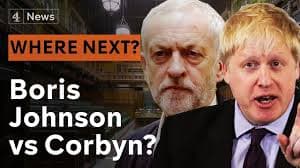
On Tuesday evening, British Prime Minister Boris Johnson and Labour opposition leader Jeremy Corbyn face each other in a live television debate for the first time. Although Johnson is constantly under fire, his archrival Corbyn is far less popular with most Britons.
Johnson also currently has the opinion polls on his side. The gap with Labour has only grown in recent weeks. Whereas the Conservatives started the campaign two weeks ago with a 10 percentage point lead, this has now risen to 14 points.
Johnson's growth is not due to his own performance, but mainly to the other parties. In particular, the decision by the anti-European Nigel Farage to have his Brexit Party contest in barely half of all constituencies means that in half the country, the Conservative Party is the only party clearly in favor of leaving the EU.
Promotion
In their campaign, the Conservatives promise to impose stricter conditions on EU citizens wishing to migrate to the United Kingdom with their Brexit plans. Johnson wants to abolish the current visa-free travel by the end of next year. By 2021, new British regulations will have to be introduced.
Johnson wants immigrants to be admitted only if they have a job and an income. Currently, an EU citizen can stay in another EU country for a certain period to look for work, and Europeans are entitled to social benefits after three months. The Conservatives want to extend that to five years. The Conservatives will make exceptions for highly educated scientists and people who want to start their own businesses.
Given the opinion polls, there is a chance that neither party will secure a majority in the House of Commons on December 12 on their own. In that case, the Labour opposition does not intend to form a coalition with other political parties. Party leader Jeremy Corbyn made this clear in an interview with the BBC. When asked if he would consider making a deal with the Scottish National Party (SNP), Corbyn replied: “We do not make deals with anyone.”
Currently, Labour is trailing the Conservatives in the polls. Nonetheless, Corbyn is not inclined to potentially form a coalition with the Scottish nationalist SNP. That party could support Labour in the House of Commons in exchange for a second referendum on Scottish independence. Corbyn says that the SNP will soon face a choice in the House of Commons: do they want to help Boris Johnson return to power, or support Labour?
If Labour wins the elections, the party wants to renegotiate the terms of Britain's departure from the EU and hold a second referendum on it. Whether the party will campaign for or against EU membership remains something Corbyn still refuses to say.
The pro-EU political parties such as the Lib Dems, SNP, and the Greens are angry at commercial broadcaster ITV for not allowing their party leaders to participate in the debate. They point out that both the Tories and Labour support Brexit, and others are not given a voice.