

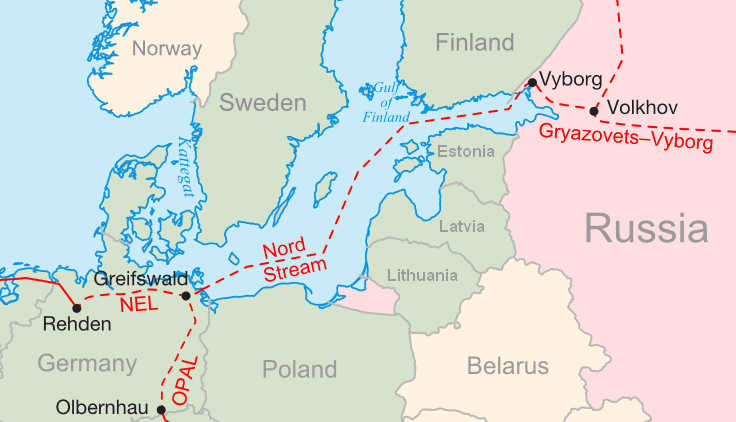
Denmark has become the last European country to approve the route for the construction of the Nord Stream 2 gas pipeline. This seems to remove the final geopolitical obstacle for the full construction of the new pipeline through the Baltic Sea, intended to supply Western European countries with Russian natural gas. Other required permits from various countries and authorities were already obtained. Several legal procedures are still ongoing, but they can no longer block the project.
Nord Stream 2 will be 1200 kilometers long and will connect Russia with Germany via the Baltic Sea. The pipeline crosses not only Danish but also Finnish and Swedish waters. Denmark is now the last country to have issued all necessary permits. However, the route chosen by Nord Stream 2 was not approved; instead, an 8-kilometer longer route was accepted to minimize the impact on the environment and shipping.
Before the end of the year, the first gas is expected to flow westward through Nord Stream 2. The pipeline construction in Russian, Finnish, and Swedish waters is already completed, while work in German waters is largely finished.
Promotion
The project is led by the Russian state-owned company Gazprom and is a joint venture with five European energy companies, including Engie and Shell. The construction of this new gas route to Western Europe has long been a subject of controversy. In some European countries, the pipeline is sensitive due to concerns that Europe will become more dependent on Russian gas. However, countries like Germany, the Netherlands, and Austria strongly support it.
The United States also intervened in the debate and even threatened sanctions earlier this year against companies involved in its construction. The U.S. fears increased Russian influence in Western European countries. With the pipeline, Gazprom will no longer be solely dependent on the current pipeline running through Ukraine, which could cut off transit to EU countries. Russia and Ukraine have been at odds for years.