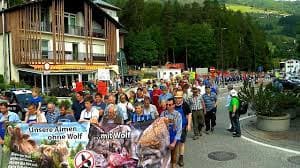
A few thousand Austrian farmers demonstrated at the regional parliament in Innsbruck against the increasing nuisance caused by wolves. The state parliament of Tyrol is discussing on Wednesday and Thursday an initiative proposal from the conservative-green coalition to take action against the growing number of wolf attacks on livestock in the Austrian mountains.
The farmers marched through the city center with several hundred sheep and cattle, bells on the cows included. The demonstration in Innsbruck proceeded peacefully. At the police's request, some protesting young farmers left their pitchforks inside the livestock vehicles.
“To make city residents clear that we want to be rid of this wolf nuisance in the countryside,” said one of the organizers. “The return of the wolf should not be seen as just a rural issue. On the contrary, the city population needs to be made aware that this matter will soon affect us all,” said Josef Geisler, chairman of the farmers’ union.
According to the Tyrol state government, more than 145 animals have already fallen victim to wolf attacks this year on the Alpine pastures of Tyrol. It is estimated that about 50 wolves currently live in Austria. If this population continues to develop unhindered, experts expect there could be up to 500 wolves within the next 15 years.
Calls for the “removal” of wolves are growing louder, but politicians from almost all parties acknowledge that shooting wolves is not yet legally possible under the European directive. The wolf has been a protected species for over thirty years because it was once at risk of extinction.
Since herd protection by erecting fences in the mountains of Tyrol is not feasible everywhere, an exception to the Habitats Directive is now being considered.
This would exempt rocky and mountainous areas where livestock graze. In that case, an amendment to the current directive or at least permission for exceptions would be required in the EU.
The protesting farmers say the Habitats Directive was established thirty years ago to prevent the wolf from going extinct, but that risk no longer exists.
The proposal now is to designate small pasture protection areas where—after a decision by a specialized four-member supervisory council—wolves may be trapped or, if necessary, shot. German Agriculture Minister Julia Klöckner recently made a similar proposal. It is also included in the CDU/CSU election program.
In the Dutch border provinces and Belgium, there are also growing calls to ease hunting bans on geese and wolves.