

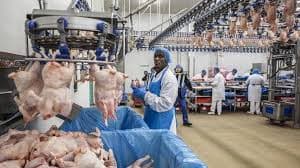
In the German Bundestag, the Committee on Labour and Social Affairs approved the new stricter law on working conditions in German slaughterhouses. The final vote in the plenary session of the Bundestag is scheduled for next week.
All parliamentary groups except FDP and AfD voted in favor of the ban on temporary agency workers in the meat processing industry. In the Netherlands, the trade union federation FNV advocates a similar approach.
From now on, the use of temporary contracts is prohibited in German slaughterhouses, and from April, temporary agency work will only be permitted to a limited extent. Companies may only cover work peaks with temporary agency workers based on a collective labor agreement. Small companies with fewer than fifty employees are exempt from this law, as are sales staff and interns.
Promotion
The German Meat Association (VDF) criticizes the legal tightening and accuses politicians of lacking knowledge. The meat industry has been willing for months to forgo labor contracts but argues for a voluntary arrangement. According to the association, the ban on temporary agency work will lead to problems, especially in the production of seasonal meat products.
There will also be a better legal regulation for small regional slaughterhouses that are nominally independent cooperatives but are in practice branch offices of large slaughterhouses. This would mean the end of any division of tasks and cooperative collaboration between meat companies, warns the VDF. This would especially affect the regional slaughterhouses that could only survive with this cooperation.
Earlier this year in the Netherlands, an investigation was started into housing, employment contracts, and working conditions in slaughterhouses after many coronavirus infections were found among staff. To address this, the ‘Task Force Protection of Labor Migrants’ led by former SP leader Emile Roemer made several recommendations last October.
The Roemer committee called for better regulation. For example, the uncontrolled proliferation of up to 14,000 temporary employment agencies must end. John Klijn of FNV says he ‘takes his hat off’ to Roemer’s report but wants to take it a step further, as the TV program EénVandaag previously reported.
“What the Roemer committee has done, I take my hat off for. As far as I’m concerned, all recommendations should be adopted one on one,” says Klijn. But he feels it does not offer a real solution. “Because the core of the problem remains: the thousands of people in the meat sector who come in as flexible workers.”
“That’s why I am so impressed with what Chancellor Merkel has done in Germany,” he explains. After various coronavirus outbreaks in the meat processing industry, German politics intervened. An important cause was temporary agency work. People lived together in large groups and were deployed in different companies.
“Now it’s over, people just have to become employees of the slaughterhouses,” Klijn sums up the German law. “And that has already had an effect. The biggest players in the meat sector, such as Vion, which also operates in the Netherlands, have already taken on 3,300 employees.” The FNV official hopes the German example will be followed in the Netherlands, and that politics here will also move towards a significant restriction of temporary employment agencies.