

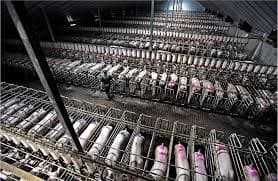
The German Bundesrat has, after years of discussions, approved a new Animal Welfare Act. This law imposes much stricter requirements on pigsties.
The Ministry of Agriculture estimates the costs for converting pigsties at around 1.1 billion euros. At least 300 million euros can be drawn from a subsidy scheme for adapting farm buildings, some parts of which must be completed within five years and others within ten years at the latest.
The German federal government has been discussing tightening this law for years, which had previously been adopted by the Bundestag and regional parliaments. Some federal states wanted a much more comprehensive law, while more agrarian states opposed it.
Promotion
After several failed attempts and compromise proposals, the Bundesrat approved a plenary motion Friday evening submitted by the federal states of North Rhine-Westphalia, Schleswig-Holstein, and Lower Saxony.
The new law prescribes, among other things, how long sows may stay in the farrowing crate. In the farrowing crate, sows have temporarily less freedom of movement to prevent them from lying on their piglets. A ban on steel lying boxes will also be introduced.
Five years ago, the court ruled that the situation in the current stables was illegal because the pigs could barely stretch their legs. The current proposal from Minister of Agriculture Julia Klöckner provides for an enlargement of the lying stalls, with spaces at least 2.20 meters long and 65 to 85 centimeters wide. Farmers will have 15 years to convert their stables.
Minister of Agriculture Julia Klöckner said about this: “We encourage the transition. At the same time, legal and planning certainty has now been created for farmers in Germany.” Small and medium-sized farms must also be able to keep sows sustainably. The funding helps to comply with the new requirements on time, the German government says.
After a transition period of eight years, sows may no longer be kept in crates. They will then only be allowed to be kept in groups. Fixation will only be permitted for a short time. The group area must cover a floor area of at least five square meters per sow. Feeding troughs may still be used. An activity area must also be provided for the animals.
The vote on larger stalls had already been removed from the Bundesrat agenda in February. Shortly after that postponement, the coronavirus crisis broke out.
There is still no uniform EU regulation on farrowing crates. Denmark, the Netherlands, and Austria have legal provisions on staying in farrowing crates; in Sweden this practice has been banned since 1988, and in Great Britain since 1991.