

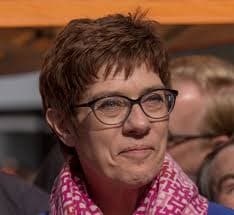
In Germany, CDU party chairwoman Annegret Kramp-Karrenbauer has announced her resignation. It was expected both in German and European politics that she would become the successor of Chancellor Angela Merkel.
Two years ago, she took over the party chairmanship from Merkel. AKK now says she will not stand as a candidate for chancellorship next summer, although Merkel already announced her resignation last year. This has created great uncertainty not only in Berlin about who will be the new German leader in barely a year and a half.
Kramp-Karrenbauer reportedly stated in a party board meeting that the chancellorship (or at least the candidacy for it) and the party chairmanship should be held together, to avoid weakening the CDU by having two leaders. Some see this as a veiled call for Merkel to step down early, so that AKK can hold both positions.
Promotion
Angela Merkel had held both positions for years, but passed on the party chairmanship at the end of 2018, which was widely seen as the first step in handing over her entire political legacy.
According to AKK, there is uncertainty within the CDU about how to deal with extreme political parties such as the far-right AfD and the far-left Die Linke. Kramp-Karrenbauer is strictly against any cooperation with either party, but not everyone in the party agrees. This has put the party chairwoman under pressure for some time, especially since the current coalition between the CDU and the Social Democratic SPD is not running smoothly, and many already anticipate the fall of the "grand coalition."
In the most recent (European) elections in May, the two major German centrist parties SPD and CDU/CSU lost many voters, mainly to the Greens on the left and to the AfD on the right. In recent negotiations in the state of Thuringia about forming a regional government, the regional CDU leaders refused to form a coalition with the Greens and Die Linke, and appeared willing to accept tacit support from the far-right AfD.
This sent shockwaves through Germany, as it was the very first time a party voted together with the far-right. Party chairwoman AKK apparently failed to impose her vision on the regional party division, leaving that impression. This led to fierce criticism in the right-wing German press and a thinly veiled call for her resignation. It is not yet clear whether the party board urged her to resign, whether she decided it herself, or whether Chancellor Merkel pushed for it.
But even before the recent crisis in Thuringia, there was criticism of how Kramp-Karrenbauer led the party, primarily due to election losses and poor poll results. In November, she already threatened to resign during the party day in Leipzig. With that maneuver, she managed to restore unity at that time.
Kramp-Karrenbauer is also recently Germany's Minister of Defense, succeeding Ursula von der Leyen who became President of the European Commission in December. Kramp-Karrenbauer wants to soon organize the process of electing a chancellor candidate and further prepare the party for the future, with plans to give up the chairmanship after the summer.
New parliamentary elections will take place in Germany in 2021, marking an end to the Merkel era after sixteen years. The current chancellor reportedly thanked AKK extensively at the party board and asked her to remain as Minister of Defense.