

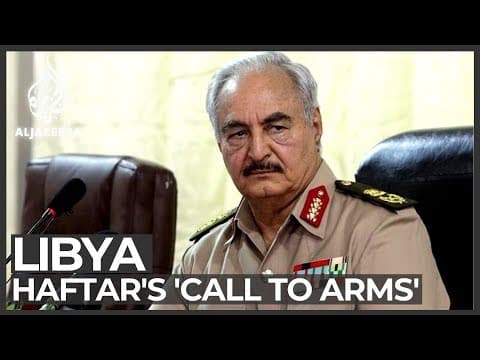
Libyan warlord Khalifa Haftar has rejected a call from Turkey and Russia for a ceasefire in Libya. Instead, he announced the continuation of his military operations. He also dismissed a ceasefire appeal following a meeting with EU President Michel. EU leaders also met with envoys from the Libyan government.
Haftar says that the revival of the political process and the country’s stability can only be ensured through the “eradication of terrorist groups” and the dissolution of militias controlling the capital Tripoli.
Libya is currently governed by competing authorities, each with their own army and supported by (partly foreign) militias. Haftar’s government is backed by the United Arab Emirates, Jordan, and Egypt, as well as France and Russia. The government in Tripoli receives assistance from Turkey, Qatar, and Italy.
Promotion
Haftar’s forces launched an offensive against the capital in April, the seat of the UN-recognized government of Prime Minister Fayez al-Serraj. Haftar’s militias also captured the key coastal city of Sirte this week.
The EU also called for a ceasefire this week. Both Prime Minister al-Serraj and Haftar were in Rome on Wednesday for meetings with Italian Prime Minister Giuseppe Conte. Conte is trying to play a mediating role in establishing a ceasefire.
The Turkish parliament gave approval on Thursday for the deployment of troops to Libya, following a separate agreement on sending military experts and weapons signed in December. Haftar’s Libyan National Army (LNA), with its superior air capabilities and backing from regional powers, has so far held the military advantage.
Libya has descended into chaos since a 2011 NATO-backed uprising killed the long-standing dictator Muammar Gaddafi and is now divided between the GNA and Haftar’s rival authorities in the country’s east.
Tensions escalated last year when Haftar launched an offensive to capture Tripoli, aided by the UAE and Russian mercenaries from the Wagner group, led by a close ally of Russian President Vladimir Putin – although Moscow denies involvement.
However, the conflict in Libya has exposed some disagreements among EU countries. France has sided with Haftar, while Italy and other EU nations support Serraj and the GNA, which they regard as the legitimate, internationally recognized government after it came to power through a UN-mediated power-sharing arrangement.