

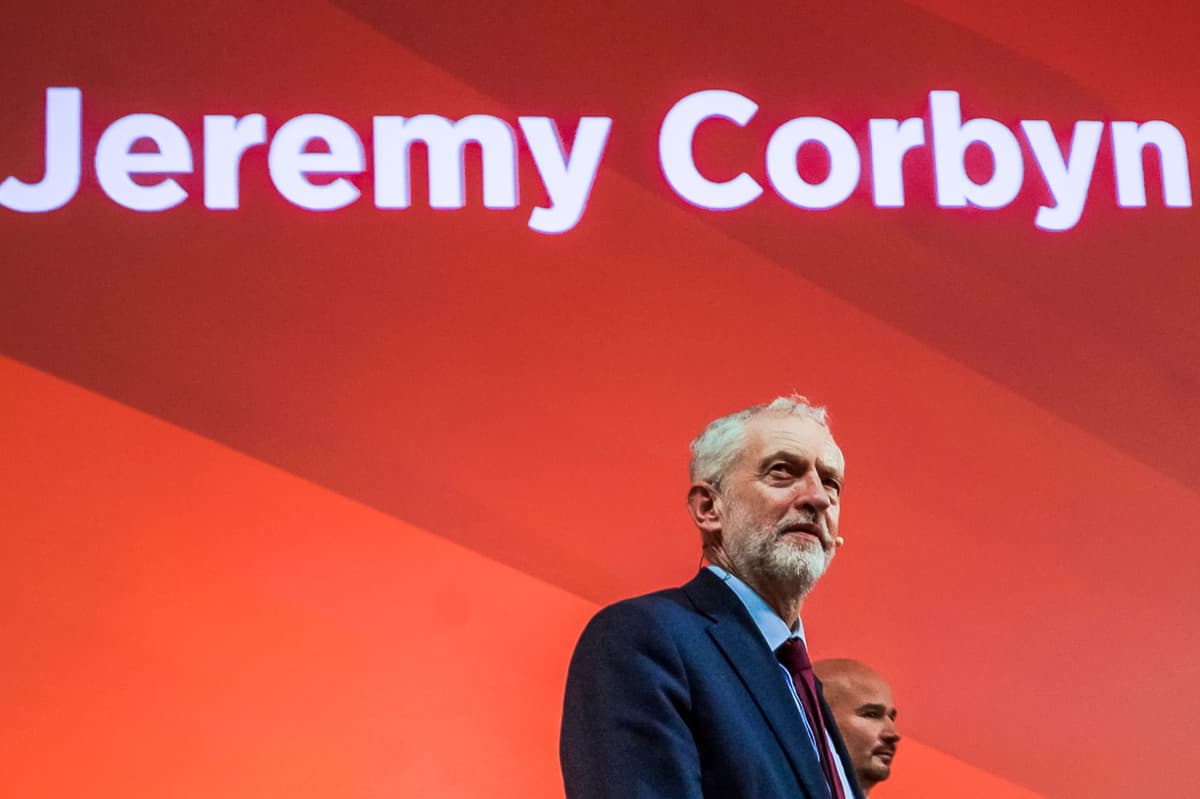
British opposition leader Jeremy Corbyn will put any Brexit deal he reaches with the European Union to a referendum for the British voters, and will accept the result. Labour leader Corbyn said that as a future prime minister, he will present his potential Brexit arrangement to the public ‘without a voting recommendation,’ and that he will not resign if it is rejected.
This stance places the Labour Party exactly in the middle ground between Boris Johnson’s Conservatives (who want to leave the EU no matter what) and the Liberal Democrats (who want to remain in the EU at all costs). If he wins the election, Corbyn wants to renegotiate with the EU on a different, smaller Brexit deal. Labour wants to remain economically partly connected to the EU and aims to protect businesses as much as possible.
After new negotiations with the EU, Corbyn intends to hold a referendum on the agreed terms—the how—unlike in 2016 when the question was whether or not the UK should leave the EU. Within Labour, there has been intense internal party conflict for months over such a second referendum.
Promotion
The ‘neutral’ position now chosen by Corbyn is meant to enable him to implement the outcome of such a second public vote in a “credible way,” Jeremy Corbyn said in a BBC television program with voters. In this way, Labour’s vision lies between the Conservatives and the pursuing Liberal Democrats. In opinion polls, the Conservatives still hold a significant lead over Labour.
In the BBC television program, Corbyn also made an important concession to the Scottish National Party (SNP). The SNP wants to hold another referendum on Scotland’s independence. A few years ago, a majority of Scots rejected such a separation from Great Britain. SNP party leader Nicola Sturgeon now expects more success because a majority of Scots wish to remain in the EU, while a majority of Britons want to leave.
Until now, Labour leader Corbyn did not wish to make a statement on this issue, but after the elections he may have to form a coalition with the SNP if he does not secure a majority on his own in the House of Commons. Corbyn said in the TV debate that he does not want to discuss Scottish independence ‘in the coming years.’ Nicola Sturgeon interpreted this as Labour not opposing independence in principle and made it clear that she would prefer to work with Corbyn rather than with Johnson if necessary.
The leader of the Lib Dems, Jo Swanson, positioned herself in the TV debate as a modern, liberal, pro-European politician who firmly rejected any hint of a referendum or exit from the European Union. She was accused by other politicians of having agreed to a referendum in 2016 as part of an attempt to bridge the political divide between pro- and anti-EU factions with the Conservatives and to form a coalition government.
Furthermore, Swanson reiterated her stance that she would not provide parliamentary support for a premiership of either Boris Johnson or Jeremy Corbyn in the event of a minority government in a divided parliament.