

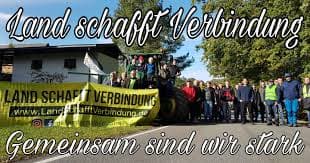
Within the German 'radical' agricultural umbrella organization Land schafft Verbindung (LsV), a split has occurred. In four federal states, the angry farmers have broken away from their national association.
In recent years, LsV regularly organized demonstrations and blockades in German city centers with hundreds of tractors. Their criticism is directed not only at German politics, supermarkets, and environmental movements but also at the consultation model of the German agricultural association DBV.
The LsV umbrella—like many other organizations and institutions—is divided into autonomous branches per federal state. The LsV associations of North Rhine-Westphalia, Rhineland-Palatinate, Hesse, and Mecklenburg-Western Pomerania no longer identify with the actions and decisions of their national representatives and have separated themselves. The interests of all regional branches could no longer be reconciled within the umbrella, according to the statement.
Promotion
Within the organization, disagreements and increasingly divergent structures had been simmering for months, the four report in a joint press release. For several years, a fierce debate has been raging in agriculture and livestock farming about a more climate- and environmentally friendly agricultural policy, reducing soil and air pollution, improving animal welfare, and lowering the use of manure and chemical pesticides.
Both the German coalition of Chancellor Merkel and Minister Klöckner, as well as the opposition and the Borchert expert committee, have presented far-reaching proposals on these issues. These are currently part of the campaign for the federal elections at the end of September.
The four dissatisfied state LsV members want to distance themselves “from dubious political symbols […] and recent ill-considered actions against individual politicians.” With this, they refer to actions by local LsV groups that publicly seek cooperation with the far-right AfD. They also reject the 'seeking out and threatening' of state politicians.
A call to “destroy politicians” was supported by some branches. According to the four, this hinders constructive dialogue with politicians and the government. Moreover, such actions do not fit the basic principles of LsV and damage the credibility of all farmers.
In addition, the regional associations criticize the behavior of the federal umbrella organization regarding the upcoming federal elections. A survey was recently sent around among the members, which critics interpret as recommending and condemning certain German politicians and political parties.
For the representation of agricultural interests, cooperation is necessary with other German agricultural trade associations—such as the German Farmers' Association (DBV), according to the four LsV regions. However, the national DBV is rejected by many dissatisfied German LsV farmers.
Angry German farmers accuse their national umbrella group of spending too much time at ministerial meeting tables (in Berlin and in the sixteen federal states) and too little time demonstrating and standing firm. DBV chairman Joachim Rukwied recently said in response to this LsV criticism that compromises and decisions simply are not made on the streets.