

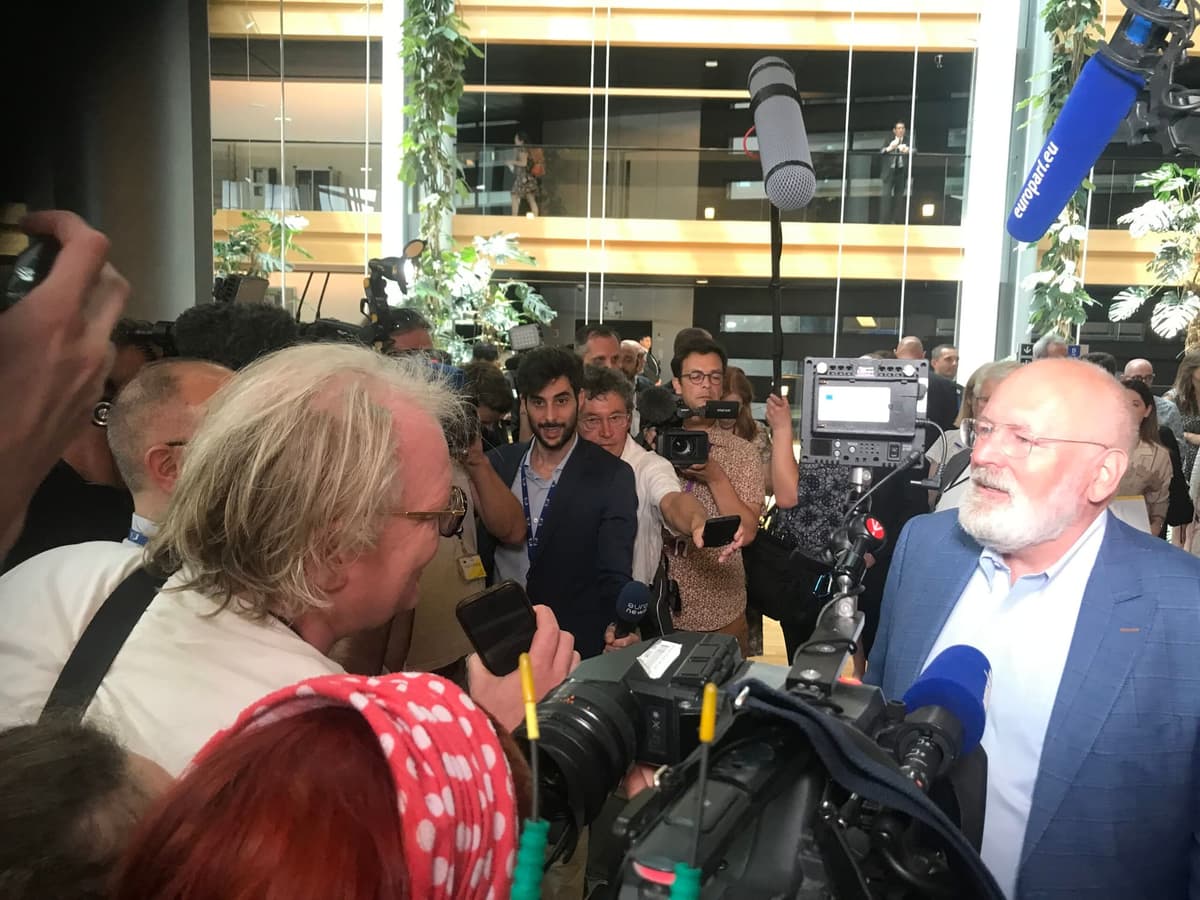
Frans Timmermans, currently serving as the EU climate chief, has decided to leave Brussels and return to the Netherlands to become the lead candidate of a new coalition of two parties: the left-wing Social Democrats (PvdA) and the Greens (GroenLinks). According to various opinion polls, the proposed new party combination under Timmermans’ leadership has a good chance of emerging victorious in the early parliamentary elections on November 22.
The Dutch political landscape has become very fragmented in recent years and currently counts twenty different small factions and personal breakaway groups, including two far-right factions (FvD, anti-EU and PVV, anti-Islam) and the agrarian rural party BBB. As a result of recent political shifts, other prominent Dutch political figures have also announced their departures from The Hague.
The premature fall of Mark Rutte’s five-party (centre) coalition had long been expected by many political observers because his cabinet was essentially a continuation of his previous government that collapsed in 2021. That government had to resign after it came to light that the Dutch Tax Authority had discriminated against residents with foreign surnames for years and labeled them as fraudsters.
Promotion
Several ministers then shamefully withdrew from politics, but Rutte stood for re-election and after difficult negotiations was appointed prime minister again.
The now departing EU Commissioner Timmermans was formerly a Dutch diplomat (including in Moscow), parliamentarian, and Minister of Foreign Affairs. In 2014, he attracted international attention at the United Nations when he accused Russia of shooting down MH17 over Ukraine and supported Western sanctions against Moscow due to the occupation of Crimea.
After the 2019 European elections, Timmermans was briefly a contender to become the new President of the European Commission as the lead candidate of the S&D social democrats, but the European heads of state ultimately chose the German Christian Democrat Ursula von der Leyen.
As First Vice-President, Timmermans has in recent years been responsible for setting up the European Green Deal, the climate and environmental project combating global warming and resource depletion. Dozens of laws targeting air and soil pollution have since emerged from this, along with adjustments in agricultural and nature legislation. Moreover, the shift towards sustainable solar and wind energy has received a major boost under his leadership.
The combination of Timmermans’ experience, his focus on climate issues, and broad support from the PvdA and GroenLinks in the opinion polls places him in a strong position to dominate the November elections and potentially become the next Dutch prime minister. It is clear that with his impressive track record and ambitious vision, Timmermans will be an important player in this exciting period for Dutch politics.
The news of Timmermans’ return to Dutch politics has also drawn international attention. His term in the European Commission was due to last until the end of 2024, but Commission President Ursula von der Leyen will now have to appoint a replacement for the departing Dutch commissioner. She will of course do this in consultation with outgoing Prime Minister Rutte, who has previously stated multiple times that he does not aspire to any international EU position.
In theory, Von der Leyen can appoint one of the current 27 Commissioners as a temporary replacement, arguing that most major climate and environmental decisions have already been made and that the current Commission will be less active next year (due to the European election campaign in June 2024).
For the period of barely a year, the current Dutch chief negotiator under Timmermans, former minister Diederik Samsom, could also take over the position of his departing boss.