

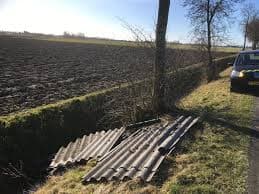
The European Commission wants to significantly tighten the directive against asbestos pollution. Brussels aims to tighten the limit value set fifteen years ago by a factor of ten: from 0.1 to 0.01 asbestos fibers per cubic centimeter of air.
Last year, the European Parliament even called for lowering the limit by a factor of one hundred. EU Commissioner for Social Affairs Nicolas Schmit says that at such low levels it becomes difficult to accurately measure compliance. At the same time, costs for companies would rise sharply. Therefore, Schmit finds ten times stricter standards sufficient for now.
Several EU countries already voluntarily apply the stricter limit of 0.01. After the tightening, workers will have to wear better protective clothing and respiratory masks. When processing or disposing of asbestos-containing waste, protective films should prevent asbestos fibers from spreading. This is already common practice in many EU countries.
Promotion
All asbestos has been banned in the EU since 2005, but despite this, the material is still present in older buildings. Workers face the highest risk of exposure to carcinogenic asbestos. It is used as a raw material in many products (floor coverings; hard plastics, heat-resistant panels; roofing, etc.).
During processing, this also poses a danger to employees and bystanders; a tiny asbestos fiber inhaled into the lungs can still be deadly after many years.
The European Commission’s argument that a tenfold increase in strictness is sufficient does not convince the European Trade Union Confederation (ETUC). Deputy head Claes-Mikael Ståhl laments that the Commission has “unfortunately sided with business” in the dispute between scientists and corporate lobbyists over the correct upper limit.