

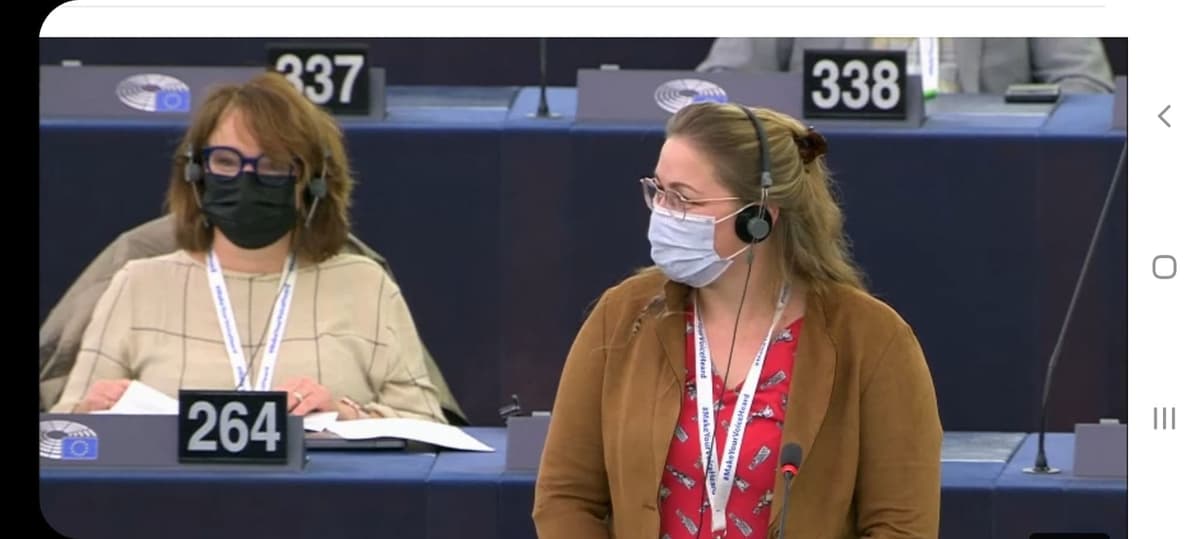
This weekend, several hundred EU citizens from the 27 EU countries gathered once again at the European Parliament in Strasbourg to debate ‘the future of Europe’. Among them were – just like in the two previous EU citizen panels – about ten Dutch participants. This time, the discussions focused mainly on climate change, environment, and health.
The panel “Climate change, environment/health” addressed the consequences of climate change, environmental issues, and emerging health problems. These topics are also related to agriculture, transportation and mobility, energy, and the transition to low-carbon societies.
“If we want to leave a cleaner Europe to our (grand)children by 2050, we must start changing our own behavior today. The EU could definitely set a good example itself,” noted Dutch participant Marieke Lopers (living in Smilde) in a speech to the plenary session.
Promotion
As a change manager in the chemical industry, she told her hosts that vegetarians at the European Parliament’s canteen should not have to request a special menu; instead, vegan should be the default option on the menu, and meat-eaters should have to ask for their meat.
Conference attendees shouldn’t automatically be transported by bus from their hotel to the parliament either. She observed that most participants can easily walk for fifteen minutes. And if necessary, they should be able to request bus transport.
Lopers, mother of two school-aged children, also emphasized the importance of education. “It’s about what is standard and what is the exception. Behavioral change starts with yourself. We can already begin this at schools. Look at how in Norway or Poland it’s very normal for children to spend one day a week in the countryside to learn about growth and life, both of humans and animals.”
According to her, the EU could stop the multi-million euro advertising campaigns promoting meat consumption. In trade agreements and in agriculture, the European Union could also act more assertively.
“Why do we import millions of kilos of soy as animal feed from the other side of the world, feed and fatten animals on a few hectares of Dutch soil with it, which are then again exported as livestock or meat to the other side of the world? What do you think that costs in fuel, energy, and environmental pollution?”
Lopers said that in discussions about European issues, financial costs are still too often the first point of focus. According to her, the primary consideration should be how polluting or wasteful something is. There is still no price attached to much environmentally harmful behavior.
“And that also applies to all the financial support to weaker EU countries: we shouldn’t support those countries with money, but with our knowledge and expertise. The Netherlands could benefit from that as well. Subsidies should only be a third or fourth option,” she added.
Lopers drew a comparison with the common reasoning about development aid: you should not give the poor food, but a fishing rod, and teach them how to fish...
The Conference on the Future of Europe started this spring and continues until spring 2022. The organization of the consultation process is in the hands of the Conference on the Future of Europe, which includes politicians representing the European Parliament, European Commission, and EU countries. In addition, several EU countries, including the Netherlands, have prepared their own EU future vision.
With the citizen dialogue "Kijk op Europa" (View on Europe), all residents of the Netherlands can share their ideas about the future of Europe. Kijk op Europa is an initiative of the Ministry of Foreign Affairs and is part of the European Conference on the Future of Europe. Ideas from residents across the entire European Union (EU) are used to formulate future plans for Europe.