

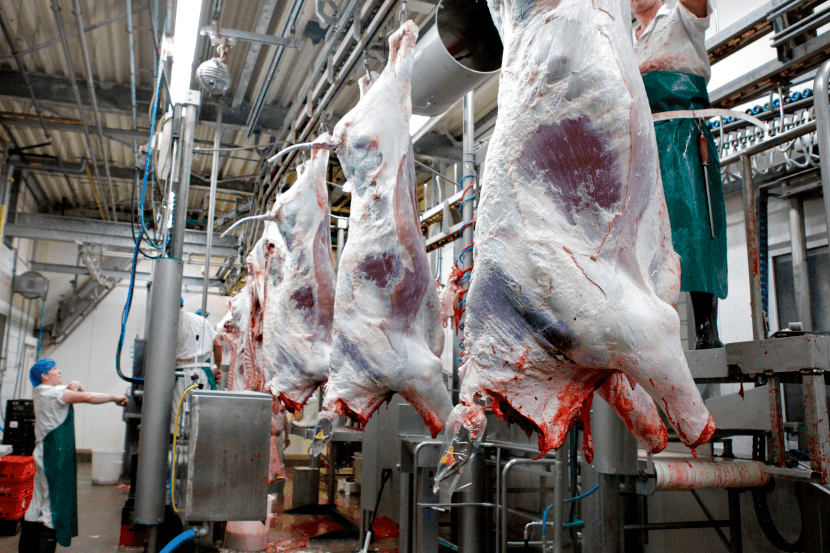
Two Members of the European Parliament from the large Christian Democratic EPP group have urged the European Commission to introduce new EU measures to combat the spread of the coronavirus in the meat industry.
The European Federation of Trade Unions in the agricultural sector, EFFAT, also condemned the working conditions of temporary agency workers in slaughterhouses in a report published on Thursday.
Following a series of corona outbreaks in meat factories across the EU in recent months, the German meat factory of Tönnies, located in North Rhine-Westphalia, reported more than 1,500 cases of the virus this week, with over two-thirds of the employees testing positive for coronavirus. For comparison: the average infection rate in the surrounding area is only 0.05%, stated Peter Liese, health policy spokesperson of the EPP group in the European Parliament.
Promotion
Liese told the news site Euractiv that slaughterhouses have several conditions that make these companies ideal breeding grounds for the virus, especially the cold, dry temperatures combined with poor ventilation and air circulation. He emphasized that these conditions are not limited to Germany but are common throughout the EU.
As such, Liese called for ventilation systems in slaughterhouses to be inspected as quickly as possible and stressed that mandatory testing of all slaughterhouse employees across the EU is urgently required, alongside strict social distancing rules.
His fellow group member Dennis Radtke, spokesperson for social policy of the EPP group, also highlighted the need for "entrepreneurial responsibility" and demanded that meat factory owners be held accountable, stating that temporary labor contracts are a major problem.
"The fact that many employees do not work directly for the company but for subcontractors and are partly pseudo-self-employed obviously leads to major problems. Therefore, we need entrepreneurial responsibility of the client, also for the conduct of so-called subcontractors."
More than 65 organizations and individuals in the production, veterinary, research, and academic sectors have recently called for legal regulation of chain liability in the meat industry. Their call to action follows the publication of a new report this week by the European Federation of Trade Unions for Food, Agriculture and Tourism (EFFAT), which judged that the "appalling labor, working, and housing conditions affect thousands of meat workers in many countries across Europe."
The study, which outlines the effects of coronavirus on the meat sector in various European countries, calls for concrete and urgent measures at both national and EU levels. The secretary-general of EFFAT, Kristjan Bragason, said that "meat and agri-food workers have too often risked their health during the pandemic to maintain the food supply."