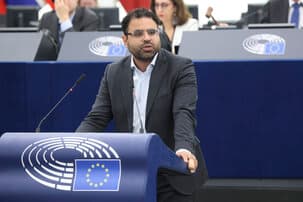
Dutch Member of the European Parliament Mohammed Chahim (PvdA) considers the agricultural criticism of the announced plans to halve pesticide use in agriculture as ‘greatly exaggerated, largely incorrect, and irrelevant’.
He thus opposes calls from the EPP Christian Democrats in Brussels to withdraw the nature and organic proposals launched in June.
Mohammed Chahim also criticizes the significant influence of the agricultural lobby in Brussels. He calls it one of the best-organized interest groups in Brussels. As the environment spokesperson for the S&D Social Democrats, he believes agriculture should use the energy and climate crisis as an opportunity to accelerate the eco-transition, rather than slow it down.
The Chair of the Agriculture Committee says the Commissioners made a mistake and should retract their proposals
“I absolutely disagree with him. For years we have heard that we must treat the planet and our way of life differently. Increasingly, young farmers, rural residents, and consumers see that ‘carrying on as usual’ leads nowhere. In that line of thinking, ‘more organic’ makes far more sense than ‘more chemical’.
But almost all experts and specialists have mountains of criticism and comments. They say the halving is not possible…
“European farmers should be very careful about whose interests they serve. Because here in Brussels, I mainly hear the smooth-talking emissaries of the chemical industry who want to push more kilograms of products onto the farmer. I don’t hear the farmer from Budel here.”
But that farmer from Budel or Lunteren wants to know what his perspective is….
“Precisely for that reason, they should look after their own perspective, not that of the chemical industry. Maybe we should bring back the Agricultural Consultant in the Netherlands: a personal advisor directly on the farmer’s own farm. And that idea from Remkes to – sort of – reintroduce the Agricultural Board might not be such a bad idea either.”
But all studies say that fewer chemicals lead to less production and lower farmers' incomes?
“Is it a disgrace if slightly less food is produced due to less agriculture? May I point out that the world already produces 130 percent of the food needs? The only problem is that we produce it in the ‘wrong’ parts of the world, and apparently cannot get it to the right place on time. And may I also point out how much food is wasted and thrown away daily?”
But what do you say to the argument that ‘less chemicals leads to less production, and with steady demand this leads to higher food prices’?
“Let me first state that I believe farmers should receive a fair price for their products. And customers should not have to pay unnecessarily high prices. So, we need to discuss pricing across the entire chain: raw materials, wholesale, transport, packaging, and everyone who currently makes substantial profits from the farmer’s work.”
“A broccoli costing 1 euro yields the farmer, as producer, only 3 to 5 cents. The same is true for many products farmers produce; that’s unfair and something we must address.”
“And when I see how millions and billions are earned by those non-producers, we should start there. Not immediately threaten to pass costs on to the shopping cart at the checkout.”
But isn’t that wishful thinking? The store manager surely doesn’t let the farmer decide how much he can charge for a liter of milk or a cauliflower versus a chicken leg?
“Then look at Germany. Former minister Borchert proposed involving the entire chain in modernizing agriculture and (especially!) livestock farming. An even better example is probably the Egalim law in France. There, the government organizes a ‘contract’ between producers, processors, traders, and sellers. Maybe we should take a look at that. Maybe Remkes can have a talk with a German or French Borchert.”