

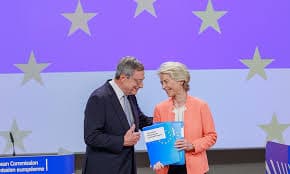
Chair Ursula von der Leyen is apparently preparing a fundamental financial reform of the EU, as revealed by (deliberately) leaked Brussels documents about the next financial period (2028-2034). These documents outline the consequences of the structural report by former Italian Prime Minister Draghi (‘the EU must become more competitive and economically stronger’) and the Strategic Dialogue on agriculture (‘EU subsidies shift from hectares to farmers' incomes, separate fund for sustainability’).
These two reports come on top of the annual political-administrative procedures for determining the annual budget (2025) and the related multiannual financial framework. Additionally, every five years, a newly composed Commission can look further ahead in its multiannual plans.
One of the variants currently under discussion (based on official preparations) is partially merging the more than 500 European subsidy funds. This would include combining the large (regional) structural funds, the common agricultural policy fund, and the rural development fund.
Promotion
Payments would then partly depend on the political good behavior of individual member states (“reforms”). Brussels intends to use this approach across many more policy areas, similar to how national strategic plans (NSPs) are already applied in agriculture. The Dialogue advice from the Strohschneider commission also advocates abolishing various binding Brussels regulations.
The EU leadership apparently no longer wants to deal with such ‘nonsense.’ Brussels would leave many details and national issues to the EU countries but wants to use payments to bind EU countries to priorities like ‘competitiveness,’ ‘innovation,’ ‘resilience,’ and ‘defense capability.’
According to the now leaked document, future agricultural subsidies must be linked to promoting organic farming by the member states; underlying this is probably the notion that the current CAP subsidies would largely be absorbed by the proposed accession of Ukraine.
In Von der Leyen’s trial balloon, a much smaller agricultural fund would be returned to the 27 EU countries, and member states would gain more autonomy in how to spend those funds nationally, albeit only after approval by Brussels.
Theoretically, it remains possible that the EU member states will continue to fragment Von der Leyen’s budget package over the many hundreds of expenditure items as usual. The European Parliament can also attach various conditions when adopting the multiannual financial framework (MFF).