

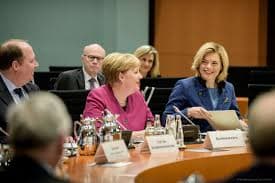
German Agriculture Minister Julia Klöckner (CDU) has, amid the escalating disagreement with Environment Minister Svenja Schulze (SPD), called upon fellow party member Chancellor Angela Merkel for help.
Klöckner has turned the opposition from the Social Democrats against her agricultural pact and the modernization of agriculture into a genuine 'chief issue.'
Climate, Environment, and Agriculture are also increasingly hot political topics in Germany. Germans will go to the polls next year on September 26 to elect a new Bundestag. Politicians and their parties are increasingly getting into campaign mode, seizing every opportunity to profile themselves to voters. In this regard, Klöckner has had almost all the winds in her favor over the past few months.
Promotion
Firstly, because Germany was the EU Presidency in the past six months. She led the Agriculture Ministers' meeting on the (future) Common Agricultural Policy. Klöckner succeeded in keeping most environmental flashpoints out of the new CAP, to the relief of many farmers and rural residents. There will be a trial period; the hottest issues have been postponed, and the financial cuts were also quite moderate. Moreover, Klöckner ensured that implementation is left to the individual EU countries themselves.
For Klöckner, it was not a Green Deal with a bit of Agriculture, but rather Agriculture with a bit of Green Deal, entirely in line with the course she wants to pursue domestically. The SPD is so far not satisfied with these 'stripped down' reforms.
Additionally, Klöckner was able to present her 'one billion euro investment subsidy for farmers' over the past weeks with much pride and fanfare. Of that billion, more than 800 million is earmarked for investments in new technology aimed at reducing manure and chemical pesticides on fields and farms.
140 million is designated for protecting birds and insects in field margins and hedges. Furthermore, 20 million is reserved for pilot digitization projects, and 24 million for innovation. German farmers can receive up to forty percent of their investment as a subsidy, with a maximum of half a million euros.
But the fact that alongside the sweet there will also have to be some sour is already clear to many for several years. Not only environmental organizations, the Greens, or the SPD believe that German agricultural policy must catch up significantly.
That Klöckner was able to postpone 'undesired' innovations is partly due to the political-administrative structure in Germany. Part of the national (federal) policy has been transferred to the sixteen federal states. Such a 'fourth administrative layer' leads to an additional layer of advisors and decision-makers and often to (even) vaguer compromises.
To steer German agriculture onto a new course, Chancellor Merkel announced a new 'Agriculture Package' at the end of last year, including 'dialogue tables' for talks among farmers, citizens, businesses, and decision-makers. And shortly thereafter, Merkel and Klöckner unveiled their billion-euro subsidy. Klöckner has done her groundwork; the election campaign is now picking up; the SPD environment minister must not block the process at the last moment….