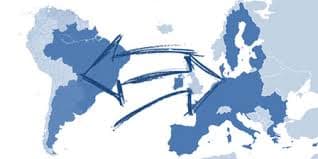
While European farmers await the consequences of a possible British-European trade agreement, they will also face the Mercosur trade agreement with four South American countries next year.
This agreement grants the largest trade bloc in South America favorable access to European markets, potentially to the detriment of European farmers and food suppliers.
The trade agreement will be submitted for approval to the EU member states and the European Parliament next spring. While Portugal prepares to take over the rotating presidency of the EU as of January 1, Portuguese leaders are expected to ensure that the Mercosur agreement is approved.
Countries such as Spain, Italy, Portugal, and Sweden want to approve the agreement, while France is outright against it, and the Netherlands and Ireland have serious reservations. Allowing (and cooperating in) large parts of the rainforest in South America to be burned down to create more farmland is especially causing protests from both environmental groups and European farmers. Brazil, Argentina, Uruguay, and Paraguay would thus be ‘destroying the climate’.
During the Agriculture Council meeting in November, agriculture ministers from Austria, Bulgaria, Lithuania, Luxembourg, Romania, and Slovakia also expressed their opposition to the Mercosur deal on sustainability grounds, with the Austrian minister of Agriculture stating that ‘the highest environmental and protection standards are non-negotiable.’ “It cannot be that the agreement will lead to further deforestation of parts of the rainforest.”
France was the first to warn that the Mercosur agreement could not be ratified due to the rapid destruction of the Amazon rainforest in Brazil and insufficient respect for the Paris climate agreement.
It is expected that EU proponents will increase their support for the Mercosur deal by adding an environmental monitoring system to the agreement.
Nine EU member states (Czech Republic, Denmark, Estonia, Spain, Finland, Italy, Latvia, Portugal, and Sweden) have written to EU Trade Commissioner Dombrovskis that “not ratifying the agreement will not only have consequences for the EU’s credibility as a negotiating and geopolitical partner, but will also strengthen the position of other competitors in the region.” Dombrovskis has meanwhile agreed with Mercosur to negotiate additional environmental protections.