

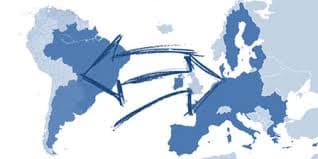
France has indeed vetoed the free trade agreement between the EU and the South American Mercosur countries at the EU level. This was already expected following earlier criticism by President Macron.
The main reason is the increased deforestation in the region. Moreover, dozens of European farmers' organizations have called not so much for adjusting or relaxing the Mercosur agreement but for its complete withdrawal. They demand regulated market access.
With the pact, the European Union and four South American countries aim to establish the largest free trade zone in the world. This should save companies in the EU four billion euros in customs duties and stimulate exports. Argentina, Brazil, Paraguay, and Uruguay are part of Mercosur.
Promotion
France is not the only critic in the EU. The free trade agreement is also controversial in some other EU countries. Austria, the Netherlands, France, Ireland, and Belgium, for example, have clearly critical voices. Germany, which currently holds the presidency of the EU Council, has previously expressed its intention to proceed with ratification, but Chancellor Angela Merkel has also recently criticized the agreement.
Therefore, agricultural circles in the EU fear that Germany, with some minor adjustments, might still manage to get the critical member states to agree and push through the slightly amended treaty.
In a joint European farmers' statement, 43 farmers' organizations from 14 countries – Belgium, Denmark, Germany, France, Italy, Croatia, Lithuania, Luxembourg, the Netherlands, Norway, Austria, Portugal, Switzerland, and Spain – and the umbrella organizations ECVC and EMB call for the agreement to be completely rejected.
“The agreement will, for example, increase imports of meat, sugar, and soy from the Mercosur countries, whose production is becoming increasingly industrialized due to aggressive export orientation,” according to one of the farmers' union chairpersons. Biodiversity in the heart of the Amazon is being sacrificed for this system. Human rights violations are also on the agenda because of this development.
”At the same time, European farming families face major challenges to produce food that is more climate- and animal-friendly, which entails higher costs on farms. The increasing and unregulated imports from the Mercosur countries also lead to mounting price pressure among European farming families.
This trade policy and the unequal production, environmental, and social standards favoring the agricultural sector accelerate the demise of farms on both sides of the Atlantic Ocean,” state the letter from the 43 unions from the 14 EU countries.