

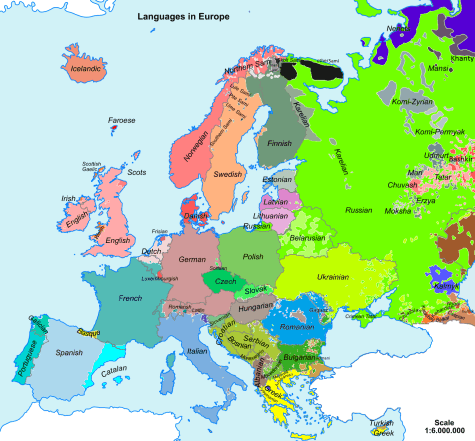
The resistance among most Britons to the European Union does not date back only a few decades, nor is it a justifiable result of incomprehensible or highly controversial undemocratic or anti-British EU measures. The fact that millions of usually reasonably thoughtful Britons voted this week for a political party advocating to leave the EU may be best explained to continental Europeans by the usually overlooked "island feeling."
For centuries, the countries of the United Kingdom managed perfectly well without the European mainland: they had their own government, their own church, their own army, their own currency; they could do without those other countries. Moreover, many Britons on their geographically isolated and hard-to-reach island(s) are somewhat nationalistic and headstrong.
This attitude is best comparable for continental Europeans to the mentality on other European islands where the population does not much care for "those people on the mainland who come to tell us what to do and also make away with our tax money."
Promotion
Sicily has its own mafia government, and Sardinia can manage without Rome; Corsica also has a separatist movement; the Canary Islands have their own parliament; Ibiza and Mallorca likewise. Many inhabitants of Crete have never been to mainland Greece (which itself consists of islands; hence also no strong national government). Greenland can do without Denmark.
Living on an island has its charms but also its drawbacks. It breeds a "we belong together" feeling, a sense of community, we know each other, we share something inevitable. And the larger the island, the more self-sustaining facilities its residents can maintain (secondary education, hospitals, railways, police force, and so forth). That is why the Irish on their Irish island also wanted to become independent.
The French and Dutch Antilles say they are best off without Paris and The Hague and want to handle their own affairs as much as possible. On many small islands there is indeed that "we belong together" feeling, but also the awareness that they still need the "other side," not only for driving lessons and a driver's license but also for hospital births or national subsidies for new sewer systems. Even if that other side is on the other side of the world.
For continental Europeans, the past few decades have shown an opposite development: their mobility increased, vacations became longer and distances became shorter. Trade became increasingly cross-border. A Swiss can drive in one day to Denmark or Spain; a Hungarian in one day to Poland or France; a Dutch person to Austria or England. Residents of Britannia do not know that feeling and do not have that experience.
That Great Britain decided in 1974 to join the twelve countries of the European Economic Community (EEC) was not a deeply experienced choice for a British national component of that group of countries, but solely a decision to join an economic-financial profit model. Most of those twelve countries were already good neighbors: the Netherlands, Belgium, the Spanish Costa Brava, and the Allied French and Germans. The EEC had proven its usefulness, and the British economy was beginning to lag behind.
That the EEC of 12 countries expanded to the EU of sixteen countries made sense to those continental countries and was essentially only an adjustment to the already existing daily practice. A single market would also benefit British companies. That the sixteen began also to consider passport-free zones (Schengen) was more than justifiable. But all that continental logic and reasoning hardly applied to most Britons: they did not go to the mainland. They had almost no business there; they already had everything themselves.
When, in 1989, the Berlin Wall fell and Eastern European countries could choose their own path and knock on the EU's door, it was continental logic to admit those countries ("the reunification of Europe"). For many Britons, the European project from 12 to 16 to 26 countries with equal rights and say for everyone led to a feeling of national loss. And so many sensible Britons say they can reason why their country is better off withdrawing from the EU.
On Thursday they can go to the polls. Essentially, there are only three options: leave the EU ruthlessly as soon as possible, withdraw later in phases on a smaller scale, or remain in the EU after all.