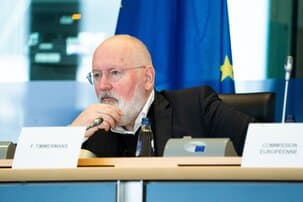
Timmermans pointed out that the EU must first undergo fundamental reform itself. This has been discussed for years, but no decisions have yet been made. For instance, small countries should no longer have veto rights over major international issues, Defense matters, or Foreign Policy. Additionally, new agreements on more and better European cooperation should be established first. Only then should new countries be admitted, some EU leaders say.
“Ukraine still needs to implement many reforms. It is a country fighting a great deal of corruption. President Zelenski is really doing his best. But it takes quite some time to reform everything.” In just over two weeks, the 27 EU heads of government will decide at the European summit whether to start accession negotiations with Ukraine.
Timmermans was until recently a European Commissioner and the right-hand man of Commission President Ursula von der Leyen. She expressed a more optimistic view in recent weeks about Ukraine’s potential accession. “I do not agree with von der Leyen,” said Timmermans. He is currently the lead candidate for PvdA/GroenLinks, the new combined green-red party, and is poised to become either prime minister or opposition leader in the Netherlands soon.
Moreover, Timmermans considers it unwise that European Council President Charles Michel has named the year 2030 as a target date for Ukraine’s accession. “It is completely unrealistic and not fair to the Ukrainians. You dangle a carrot in front of them but cannot deliver at all.”
“I understand saying to a country engaged in a severe war, fighting to preserve its independence, that we stand shoulder to shoulder in this battle. But membership in 2030 simply is not realistic,” the former European Commissioner emphasized.
Also, Joachim Rukwied, chairman of the large German farmers’ association DBV, used sharp words last week to warn against Ukraine joining the EU. According to him, this step would amount to an “exit” of family farms from the EU. Rukwied pointed to Ukraine’s large agricultural sector and the fact that the average farm in that country is many times larger than in the EU.
A common agricultural policy involving Ukraine is therefore “not feasible,” unless it is accepted that this comes at the expense of businesses in current EU countries. Rukwied also predicted that current hectare subsidies under the Common Agricultural Policy (CAP) will be completely abolished within a few years.
Direct payments are becoming less and less beneficial for farmers. Although farmers still need a transition period, it will be over by 2035 at the latest, Rukwied said. Direct payments have already been halved in recent years and could soon drop to less than 100 euros per hectare. At the DBV annual meeting, he called for a thorough revision of European agricultural policy.